Advertisement

The Welsh regions made an excellent start to their Challenge Cup campaigns, with the Dragons, Scarlets and Ospreys all winning, while Ulster secured a badly needed victory in Italy. The Sharks snatched a remarkable result in Lyon, Harlequins finally found their attacking rhythm and Bayonne left the Cheetahs wondering how a winning position had slipped away.
The Challenge Cup returned with a reminder that European rugby isn't confined to the competition with the biggest trophy. There were difficult trips to Tbilisi and Lyon, a stubborn contest in Edinburgh, a belated release of pressure at the Stoop and a rather different mood across the Welsh regions from what some supporters have become accustomed to. For clubs whose domestic campaigns have started slowly, Europe offered an opportunity to change the conversation. Others discovered that an early advantage means very little when the opposition can still find a way home. The opening round has already given us more than enough to discuss, with Castres also finding some relief through a low-scoring home victory over Benetton.


J. Rosser (4'), A. Owen (55'), A. Tuitavuki (67'), F. Paea (76')
Tries
J. Coulon (29'), P. Tuilagi (61')
de Beer (56', 68', 77')
Conversions
T. Tedder (29'), T. TEDDER (62')
de Beer (64')
Penalties
Rodney Parade has had its share of difficult European afternoons, but the Dragons made their return to the Challenge Cup feel like something worth getting excited about. Perpignan, desperate to find some confidence after a difficult start to their Top 14 season, were never going to be the most accommodating of visitors, and the contest remained awkward well into the second half. Rio Dyer, on his 100th appearance, provided the kind of threat that changed the way USAP had to defend, while Jarred Rosser continued to underline his importance with another try. The Dragons' attacking ambition occasionally ran ahead of their accuracy, and Perpignan even worked their way into a 14–12 advantage after the interval. Rather than retreat into themselves, the hosts responded through the contributions of Aneurin Owen, Fetuli Paea and their outside backs, eventually scoring four tries and finishing with a deserved 15-point advantage. There was plenty of resilience in the way they recovered control after falling behind. Under the new EPCR regulations, four tries alone do not guarantee an attacking bonus, but that will scarcely bother a Dragons side that needed the confidence of a European win. The bigger test is whether they can bring that belief back into their URC campaign.


E. Ashman (44'), G. Gwynn (61')
Tries
M. Jaminet (42', 65'), S. Tuicuvu (57')
J. Grayson (45', 61')
Conversions
M. Jaminet (43', 58', 66')
J. Grayson (37')
Penalties
M. Jaminet (3', 27')
Edinburgh came into Europe with momentum from three consecutive URC victories, but Toulon reminded them that comfortable domestic form doesn't automatically carry over when a French heavyweight arrives. This was a far more controlled contest than the free-scoring matches elsewhere in the round, and Toulon were comfortable allowing their kicking game and defensive organisation to set the terms. Melvyn Jaminet was central to the visitors' success, contributing 22 points, including two tries, and repeatedly punishing Edinburgh when opportunities appeared. The Scottish side had enough possession and territory to keep the scoreboard close for long periods, but they lacked the same sharpness in turning good positions into points. With Toulon still adjusting after Pierre Mignoni's departure, this was an encouraging demonstration that the side can produce a measured away performance amid considerable off-field change. Edinburgh won't need to panic about a first defeat, but it did expose a gap between having the ball and doing something decisive with it. They have been excellent at finding ways to win in the URC. Against Toulon, it was the visitors who managed the important moments better.


A. Seguret (21'), M. Ioane (29'), L. Baret (45'), G. Lorre (66'), B. Couilloud (79')
Tries
L. Bester (6'), J. Williams (17'), P. Ganyane (35'), N. Hatton (55'), Z. Siyaya (61'), L. Bester (81')
P. Jackson (22', 30', 46', 79')
Conversions
J. Hendrikse (18', 36', 56', 62', 82')
Lyon thought they had rescued this one. With the clock moving into its final moments, Baptiste Couilloud helped drag the French side level at 33–33, turning a difficult evening into the prospect of a result. Unfortunately for the home crowd, the Sharks hadn't finished. Young replacement Lili Bester crossed late to snatch a 40–33 victory and give the South African side a memorable opening away win. It was a contest played at the sort of pace where both defences seemed permanently one phase behind, with Lyon threatening through their ability to move the ball into space and the Sharks repeatedly responding with pace and directness of their own. The visitors scored six tries to Lyon's five, a useful reminder that a high-scoring victory doesn't automatically deliver an attacking bonus under the new three-try-margin rule. The Sharks will take enormous encouragement from responding to the late setback instead of settling for a draw, particularly after some uneven domestic performances. Lyon, meanwhile, have now found another way to lose a match they were close enough to win. Their attacking ability is obvious, but conceding 40 at home is rarely a sustainable strategy in Europe.


G. Spenderashvili (19'), O. Giorgadze (77')
Tries
G. Evans (7'), M. Morse (11'), H. Sutton (24'), L. Morgan (34', 43'), L. Lloyd (49'), K. Hire (61')
L. Tsirekidze (20', 78')
Conversions
L. Creighton (34', 62')
An away fixture in Georgia is never quite the straightforward box-ticking exercise it may look like on paper, but the Ospreys handled the challenge with authority. Black Lion were determined to make their home crowd a factor, and the visitors needed to be sharp in the collisions and disciplined around the breakdown to prevent the match becoming an arm wrestle. Instead, they gradually found the space to bring their attacking runners into the contest, with Luke Morgan crossing twice and the likes of Morgan Morse, Huw Sutton and Lewis Lloyd contributing to a seven-try performance. The final score was a convincing 39–14, and the five-try difference earned the Ospreys an attacking bonus under the new format. Perhaps the most encouraging element was the involvement of younger players, who looked comfortable taking responsibility in a European fixture rather than simply following the senior names around the field. Black Lion still offer an important challenge to visiting sides and their inclusion matters for the development of Georgian professional rugby, but the Ospreys were deserved winners. For a club that has had to work hard for consistency, this was an excellent opportunity seized rather than wasted.


G. Licata (43'), A. Ortombina (63'), G. Montemauri (72')
Tries
H. Walker (12', 28'), J. Stockdale (20'), D. McCann (47'), M. Lowry (70'), M. Moloney (77')
G. Re (44'), G. Montemauri (63', 73')
Conversions
N. Doak (13', 29', 48'), J. Benson (71', 78')
Ulster haven't exactly made a habit of giving their supporters stress-free weekends recently, so an away victory in Italy will have come as a welcome change. After a difficult start to the URC season, the province found its attacking rhythm against Zebre and scored six tries, with new hooker Henry Walker twice making the most of forward pressure. Jacob Stockdale, David McCann, Michael Lowry and Martin Moloney also crossed in a performance that blended the familiar threat of Ulster's established backs with the directness they have sometimes lacked in the tight exchanges. Zebre were competitive in spells and scored three tries of their own, but whenever they threatened to get within touching distance Ulster had an answer. The three-try margin delivered a valuable attacking bonus and gave Ulster five points to open their European campaign. The province reached last season's Challenge Cup final, so expectations in this competition are understandably higher than the league results alone might suggest. This wasn't a perfect performance and Zebre found weaknesses to exploit, but it was exactly the kind of confident result Ulster needed before another demanding run of fixtures.


S. Costelow (12'), F. Anderson (21'), J. Williams (26'), G. Davies (39'), E. Mee (54'), M. Page (55', 65')
Tries
O. Spencer (69'), O. Leatherbarrow (77')
S. Costelow (13', 26'), J. Hawkins (40', 55', 56', 66')
Conversions
J. Hodge (70', 77')
Newcastle arrived in Llanelli searching for a change of fortune after three Premiership defeats, but the Scarlets were in no mood to offer one. The hosts raced into a 26–0 half-time lead, playing with considerably more freedom than during the difficult opening rounds of their URC campaign, and they kept the pressure on after the break to finish with seven tries. Sam Costelow directed proceedings confidently, while Josh Macleod gave the Scarlets the sort of abrasive breakdown presence that stops opponents establishing momentum. Macs Page was among the standout finishers, crossing twice, and Johnny Williams had added motivation against his former club. Newcastle did show some attacking resistance after the break, but the contest had already gone, and the Scarlets were too accurate whenever the ball reached space. The result mattered for more than the five competition points: the Welsh region has spent too much of the season reacting to poor results rather than setting the agenda. This performance finally allowed its younger players and attacking combinations to show what they can do. Newcastle, meanwhile, are already discovering how difficult it is to build confidence when every small error seems to bring another score against them.


F. Bosch (14', 37'), F. Mori (19'), Y. Orabe (27'), H. Jantjies (68')
Tries
M. Annies (8'), C. Coetzee (43'), van der Westhuizen (53')
du Preez (20', 69')
Conversions
T. Swanepoel (9', 44', 54')
Penalties
T. Swanepoel (3', 25')
The Cheetahs will be wondering how they managed to leave Bayonne with just a losing bonus point. Travelling from South Africa to the Basque country is challenging enough without having to recover from a 22–13 half-time deficit, but the visitors did exactly that, gradually gaining control of the contact areas and finding enough attacking opportunities to move ahead 27–22 in the second half. For a while, it looked like the story of the weekend might be an excellent Cheetahs away victory. Bayonne, however, had one final response, with scrum-half Herschel Jantjies delivering the decisive late finish that turned the contest back in the hosts' favour. The 29–27 scoreline was tough on the visitors, who showed impressive composure after their slow start and came painfully close to a major result. Bayonne will be relieved to begin with a victory, but the vulnerability they showed after building a promising lead deserves attention. For the Cheetahs, who have fewer opportunities for high-level competitive rugby than most sides in this competition, the performance was a reminder of their quality. The points were few, but the rugby was encouraging.


C. Murley (7', 40+2'), M. Smith (15', 60'), W. Hobson (31'), S. Riley (49'), W. Evans (65', 77'), J. Staples (69')
Tries
W. Benedittis (21'), E. Benmegal (37', 42')
M. Smith (8', 16', 32', 50', 70', 78')
Conversions
J. Cotarmanac'h (21', 38')
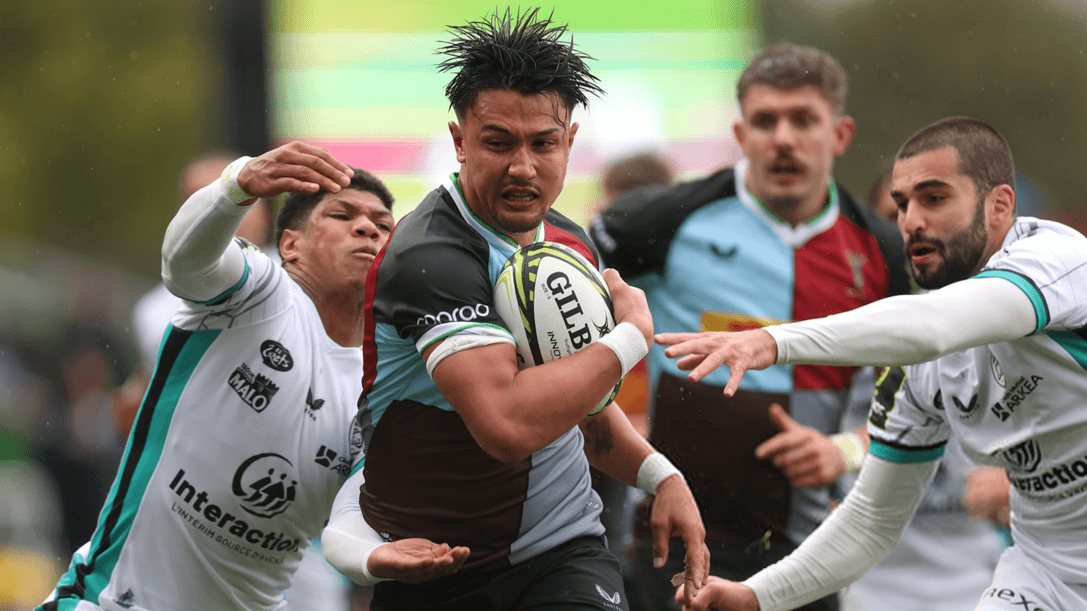
It took three Premiership defeats and a trip into Europe, but Harlequins finally remembered what happens when their attack clicks. Vannes arrived at the Stoop as a club with plenty of problems of its own after six losses in the Top 14, and the visitors simply couldn't live with the pace and variety Marcus Smith brought to the hosts' play. Smith scored twice and contributed 22 points, Cadan Murley and Will Evans both completed doubles, and Quins finished with nine tries as their backs and forwards took turns making the French defence look uncomfortable. There was still a willingness from Vannes to attack when opportunities appeared, but allowing Harlequins that much front-foot possession and broken-field space was a recipe for trouble. The result doesn't erase the questions about Quins' winless PREM start, and beating the bottom club in France is not quite the same thing as proving you're ready to challenge Europe's leading sides. It does, however, offer a much-needed injection of confidence and a reminder of the attacking talent still in the squad. Sometimes a change of competition is exactly what a struggling club needs.


V. Botitu (31'), R. Baget (77')
Tries
L. Brun (78')
Conversions
L. Brun (6', 68')
Penalties
J. Umaga (50', 54', 59')
Castres' European opener was never likely to be an exercise in free-flowing rugby. They arrived with only nine points from six Top 14 rounds, four defeats in their previous five domestic matches and a pressing need to restore some belief at the Stade Pierre-Fabre. Benetton were having their own difficult start in the URC, but brought an experienced group with plenty of international pedigree, so this was not a fixture the hosts could take for granted. An 18–9 win will not earn Castres any prizes for spectacle, but the importance of securing a result after a frustrating run is obvious. Keeping Benetton to nine points offered a more encouraging defensive return than some of Castres' recent outings, even if the narrow margin suggests the attacking work remains unfinished. For Xavier Sadourny and his players, the task is now to bring that control into the Top 14, where league position will remain the immediate source of pressure. Benetton, meanwhile, have another result to digest in a season when competitive performances have too rarely become wins. The final score is confirmed by Castres' official results page; detailed scoring incidents were not independently available at the editorial cut-off.
Round 1 Verdict
The opening weekend belonged in large part to the Welsh clubs. The Dragons, Scarlets and Ospreys all won, with the latter two turning their victories into valuable attacking bonus points, while Ulster gave Irish supporters another encouraging result after the Champions Cup successes of their neighbouring provinces. The Sharks' late win in Lyon demonstrated the entertainment and unpredictability this competition can provide, and Toulon's measured victory in Edinburgh hinted at some stability after a difficult period. Harlequins will be pleased to finally win a match, although a 57-point scoreline doesn't instantly cure everything that has gone wrong domestically. The Cheetahs deserve credit for their near miss at Bayonne, while Black Lion's presence continues to offer a different dimension to the competition. Castres also banked an important home win against Benetton after a difficult domestic start. One week doesn't determine who will lift the trophy, but it has already given a few clubs something genuinely positive to build on.