Advertisement


It's been a couple of weeks since the Japan Rugby League One officially announced the new player classification and eligibility changes for the 2026/2027 season. We had the chance to speak with JRLO Chief Operating Officer Hajime Shoji about the changes, why they are being brought in, and to clear the air on any confusion about the potential impacts.
Hajime Shoji told us, “The basic idea for this change is to enhance the motivation of the homegrown, younger players to play, while keeping an openness to international players. We believe this is very important for the sustainable growth of Japanese rugby with the increased number of local players and also the more opportunities for their long-term development.
When the changes were announced on 13th May 2025, the league confirmed it had decided to change the player category registration classification, intended to promote more local Japanese talent. To clarify, there have always been rules in place about the makeup of the squads in the JRLO and under the current League One rules, players can register in Categories A, B and C.
The latest changes see minimal changes to Categories B and C are largely unchanged, but the main change comes to Category A, which is split into ‘A-1’ and ‘A-2’.
For the changes, the average number of match day entries (matchday squad of 23 players) in Category A, who are Japanese eligible in Division One, stands at around 14, and currently this number is around 13. So there will be more opportunities allocated to the younger generation who have grown up in Japan. This should be a positive sign for those looking to start playing rugby first and eventually aim to play in JRLO. That's our expected impact on Japanese growth.”
The JRLO provided us with some key datasets which show the impact. It is important to note that some of the reporting has been on the dramatic side, and there have been emotional responses, but the proposed new changes are subtle.
We asked Hajime Shoji how he thinks the current JLRO clubs might look at recruiting differently when this comes into place before the 2026 season.
“As I mentioned, currently, the average number of player matchday entries is 13, and the minimum number of entries will increase to 14. The difference is only one.
The average player matchday entry of A-2, B and C in Division One is around 10, and in the new eligibility rule, the maximum number of entries of two categories in A-2, B and C is set at nine. This might slightly affect the demand for non-A1 players, but the actual demand for A-2, B and C will depend on the player's portfolio policy for each club. The teams have discretion in setting up how many they contract for these categories.
The league still wants to attract international talent to come and play in Japan. He explained that they are encouraged by continued interest in top-quality foreign players to play in the JRLO and showed via the statistics (if the same criteria were overlaid on players from the start of the JRLO in 2022, compared to 2025) what the changes have been.
“This change does not have much impact on the recruiting and hiring policy, and both the league and teams are highly respectful of the contribution of international players to the competitive advantage and development of Japanese rugby and the national team. We are giving our best effort to offer a good environment to the players with an international background. But we don't think there will be too much impact on the interest from international players to play in the League One, and we are highly encouraged by the levels of interest to play here.”
For Category A, the percentage of players stood at 14.8 % and has decreased to 13.2 %, for Category A-2, it has increased from 3.8 % to 5.4 %. Categories B and C have hardly changed over the past three years.
“As you said, the change at this time is not a massive change. There might be some minimal impact on international players, which is to be expected, but we are trying to build a balance between the openness of diversity and sustainability with the homegrown players,” added Hajime Shoji.
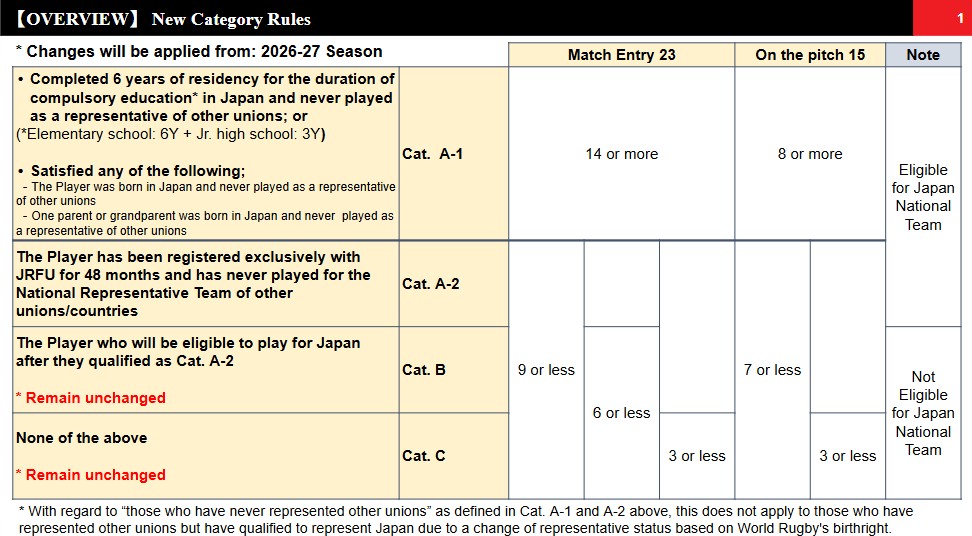
Resetting the balance in favour of Japanese players, and striking that right balance have been key phrases used to explain the changes.
We asked if these changes would be evaluated constantly and if they were agreed based on consultation between all of the clubs and the JRLO to ensure it's moving in the right direction.
“We arrived at these target numbers or these new eligibility rules after discussing them with all of the JRLO teams, and of course, they are based on the current situation or their future aspirations. We also feel that with two years' preparation for the 2026-27 season, the teams and we believe that we are gradually changing the status quo towards this goal without lots of confusion and enough time to implement them.”
One of the key areas to clarify was the discretionary assessment of players' eligibility. Some of the online feedback following the announcements was towards players who might not fall under Category A-1, even if they had represented Japan at the national level in 15s or 7s.
The best example is Honda Heat’s Lomano Lemeki, who played in the Olympics for Japan in 7s, played in two World Cups, has Japanese citizenship & he’ll still be in category A-2 from 2026-27?
The COO explained, “We are setting some additional rules for relief in the status or some specific special treatment for some specific players, like capped players in the national team and contributions such as to the Sevens national team. We have listened to some of the feedback from the fans, too, and we have to consider World Rugby rules on eligibility, where nationality is not considered for the eligibility of the national team.”