Advertisement


Pro D2 has a scarcely believable 30 rounds in the regular league season. France’s (fully professional and fully televised) second tier is a proper slog of a season.
After three whole weeks off, we now enter the finishing straight. With seven rounds (plus playoffs) still to go, you can’t quite call it a “sprint finish”, but it is fair to say that the Pro D2 run-in starts in earnest with Round 24 on Thursday evening.
This is an incredibly exciting time as minds become concentrated on finishing league position. Squads are carefully managed (i.e. rotated) throughout the season, but the break allows teams to assess the resources available, consider the possible scenarios and plan their approach accordingly.
It’s almost a bit of a gentlemen’s agreement in Pro D2 that teams don’t send their strongest sides to away games. While this is not always the case, and nor is it true for every side in the league, it is certainly the prevailing attitude. However, in the climax of the season, teams can’t really afford to throw in the towel. As with any league featuring both promotion and relegation, there are teams that feel they deserve to be in the league above, aspirational clubs that have long-held dreams of reaching the top level, and equally those for whom dropping to the league below would be disastrous for the club, the players and, arguably more importantly, their town.
Pro D2 may have a couple more sides, and therefore a few more league fixtures, but it follows largely the same format as the Top 14 when it comes to the end of the season.
The top six qualify for the playoffs, with the top two earning a direct route to home semi-finals. The Barrages - hosted by the 3rd and 4th placed sides - decide who joins them. The final is then played at the home of Toulouse, Stade Ernest Wallon. The winners are crowned “Champion de France - Pro D2” and earn automatic promotion to the Top 14, while the defeated finalist gets a second shot at promotion via the ‘Top 14 Access Match’ at their home ground against the 13th-placed Top 14 side.
At the bottom, again it is similar to the Top 14. 16th place, the ‘Lantern Rouge’ (the French equivalent of the ‘Wooden Spoon’) is automatically relegated to France’s (fully professional) 3rd tier, Nationale, while 15th place has to travel to the home of the losing Nationale finalist for the ‘Pro D2 Access Match’. There have only been two previous Pro D2 Access Matches, and both have been won by the incumbent Pro D2 side. Incidentally, the Pro D2 Access Match is due to be scrapped in future seasons, and the league will return to the bottom two sides being automatically relegated.
Now you know how it all works, here is everything you need to know about the Pro D2 season so far and what to expect from the business end.
Seventeen points clear at the top and with just three defeats to their name, Vannes have been, by some distance, the standout team this season. Their squad is arguably stronger than the one that got relegated from the Top 14 last season, and breaching the 100-point mark for the season looks inevitable.
The all-time records, however, may just remain out of reach. Oyonnax have twice reached 111 points in Pro D2 campaigns, while Lyon twice achieved a staggering 117 points. In those campaigns, Lyon won 25 of their 30 games, so for Vannes - currently on 19 wins - to surpass that total, you’d imagine they’d have to win six of their final seven games. As dominant as they have been this season, that would be a tough task - especially given they would likely want to rest players ahead of the knockouts.
And the knockouts are what matters. Pro D2 has had its fair share of sides that have dominated the regular league season only to fall short at the final hurdle. They haven’t shown too many signs that they would bottle it at the death, but it is definitely something that will be nagging away at the back of Breton minds.
Finishing 2nd in Pro D2 gives one side what is, in theory, a significant advantage, by giving them not only a direct route to a home semi-final, but also a restorative bye week at the end of a long season. However, bypassing the Barrage doesn’t guarantee any further progression, either to the Top 14, or even the final.
The two main contenders for 2nd place, Colomiers and Provence, know this just as well as anyone. Provence have lost in the semi finals in each of the last two seasons, the first of which they hosted having finished top of the table, while Colomiers were the first of the trio of clubs upset by Montauban on their way to the Pro D2 title. Colomiers lost their home Barrage last season having comfortably beaten Montauban at home a few weeks earlier.
Colomiers and Provence, currently 2nd and 3rd respectively, face each other in Aix-en-Provence in the first fixture when Pro D2 returns this week. They have been the two most consistent sides in the league and have the 2nd and 3rd highest amount of away wins. However, the similarities end there.
Colomiers have won plenty of admirers over the past year with their attacking identity and strong core of young talent. They may have built a reputation as one of the most watchable sides, but questions remain over their physicality up front. They have struggled at home against some of their promotion rivals, noticeably at scrum time, raising questions about their ability to get through knockout rugby.
By contrast, Provence have physicality and set-piece pedigree in abundance. They have added another layer of international size and quality this season, and their squad seems to have been constructed very much with the Top 14 in mind. To progress though, they will need to overcome the mental hurdles of knockout rugby that have tripped them up the last two seasons.
Talking of mental hurdles, Oyonnax have picked up a frustrating and staggeringly consistent habit of losing close away games right at the death. They have only three wins away from home, but have picked up seven bonus points (for being within five points) from their nine away defeats. They too have an almighty pack full of international experience, and their pragmatic game plan should be suited to the pressure of knockout rugby. Had a couple of those near misses ended in victory, they would arguably be favourites for the top two. As it stands, they are 10 points off 2nd place. Whether that is due to misfortune or a lack of killer instinct is up for debate.
The other contender, for at least a home Barrage match if not a home semi-final, is Valence Romans. They have had a bit of a fairytale run this season, but started to fade just before the break, losing three on the spin, although it should be noted that one with a hugely changed side at SAXV and another was a home loss to Vannes. Their fate is largely in their own hands, with their four remaining home games all against current members of the top six. They’ve got a well-oiled set piece and, in Lucas Meret, have an outstanding goal kicker: he is 27 points clear as the league’s top points scorer. That feels like a formula that will keep them firmly in the conversation when knockout rugby rolls round.
| # | Team | PL | W | L | D | PD | BP | PTS | Form |
|---|---|---|---|---|---|---|---|---|---|
| 1 |  RC Vannes RC Vannes | 23 | 19 | 3 | 1 | 328 | 11 | 89 | W W W W W |
| 2 |  Colomiers Rugby Colomiers Rugby | 23 | 16 | 7 | 0 | 240 | 8 | 72 | L L W W W |
| 3 |  Provence Rugby Provence Rugby | 23 | 14 | 9 | 0 | 167 | 14 | 70 | L L L W W |
| 4 |  US Oyonnax US Oyonnax | 23 | 12 | 11 | 0 | 210 | 14 | 62 | W L W L L |
| 5 |  Valence Romans Drôme Valence Romans Drôme | 23 | 14 | 9 | 0 | 17 | 6 | 62 | L L L W L |
| 6 |  CA Brive CA Brive | 23 | 12 | 10 | 1 | 142 | 9 | 59 | W W L W L |
| 7 |  SU Agen SU Agen | 23 | 12 | 11 | 0 | 74 | 9 | 57 | W W W L W |
| 8 |  Stade Aurillacois Stade Aurillacois | 23 | 11 | 12 | 0 | -44 | 7 | 51 | W L W L W |
| 9 |  FC Grenoble Rugby FC Grenoble Rugby | 23 | 11 | 12 | 0 | -43 | 5 | 49 | W W W L L |
| 10 |  Soyaux-Angoulême XV Soyaux-Angoulême XV | 23 | 10 | 13 | 0 | -153 | 5 | 45 | L W L W L |
| 11 |  USON Nevers USON Nevers | 23 | 8 | 14 | 1 | -177 | 6 | 40 | L L L L L |
| 12 |  Biarritz Olympique Biarritz Olympique | 23 | 9 | 13 | 1 | -81 | 6 | 39 | W L L L W |
| 13 |  AS Béziers Hérault AS Béziers Hérault | 23 | 9 | 14 | 0 | -124 | 4 | 38 | L W L W W |
| 14 |  Stade Montois Stade Montois | 23 | 8 | 14 | 1 | -252 | 3 | 37 | W W L L W |
| 15 |  US Dax US Dax | 23 | 10 | 13 | 0 | -11 | 9 | 35 | L L W W L |
| 16 |  US Carcassonnaise XV US Carcassonnaise XV | 23 | 6 | 16 | 1 | -293 | 4 | 30 | L W W L L |
The race for 6th place and that final spot in the Barrage is largely between three sides with high expectations due to former success: Brive, Agen and Grenoble.
Former European champions Brive have spent much of this campaign flattering to deceive. The budget is enormous, the squad stacked with talent and yet cohesion has been elusive. Still, if they were to make the playoffs, they remain the side that others would want to avoid. They can beat anyone on their day because of the players at their disposal, and you wonder whether they might click into gear in the run in.
Only three clubs (Toulouse, Stade Français and Béziers) have won more French championships than Agen, and after a good few seasons languishing in the lower part of Pro D2, they have an outside shot at returning to the top table. They’ve rebuilt their squad, giving exposure to a host of academy graduates, with a sprinkling of canny overseas signings providing a guiding hand on the tiller.
Grenoble, the side that have lost both the Pro D2 final and then Top 14 Access Match in each of the last three seasons, have had trouble backing up last year’s table-topping campaign. Injuries disrupted the early part of their season, and continue to do so, and they have dropped games they would have won in previous years. Their run-in includes a few such fixtures. The Grenoble of 12 months ago would have steamrolled many of the opponents facing them in the final seven rounds. They will need something special to make the Barrage - it’s not out of the question, but there is now very little margin for error.
At the other end of the table, the situation is becoming increasingly uncomfortable for some big names. Biarritz and Béziers, both steeped in history, find themselves in genuine trouble. Points deductions (5 points and 2 points respectively) arising from financial indiscretions have not helped, but wouldn’t be an issue if either side had consistently fulfilled their potential on the pitch.
For Béziers, their away form has been staggeringly bad: they are yet to pick up a single point on the road from 12 games. There has been plenty of off field noise and rumours of unrest are still knocking around. Their survival hinges on their talismanic captain, Portugal scrum-half Samuel Marques. There is arguably no player in the league, or even in France, who is more important to their team than Marques, such is the influence he has on a game. He was Pro D2 Player of the Year when Béziers finished 3rd only two seasons ago, and he was superhuman in their victory over Vannes in December.
Biarritz have shown flashes of quality without ever sustaining them. There is definitely talent in the squad, where they have combined a good crop of local youngsters with older guys returning to their Basque roots. You wonder whether that sense of identity, and the support that will garner with the local community, might give them an extra edge in the final push for safety.
Another former French championship winner, Stade Montois, are also in the mix for relegation. They may not be part of France’s rugby elite of lates as much as at other times in their history, but they are stalwarts of Pro D2 and remain an iconic club in French rugby in their own right. They have been the league’s most unpredictable side in recent years, bewilderingly dreadful at times, while also being capable of tearing teams apart at others. Like Béziers, the team from Mont de Marsan is packed with internationals from the Rugby Europe Championship nations, so they just need to knit it all together with some consistency.
At the foot of the table, Carcassonne are fighting to keep their Pro D2 status, having won promotion last year, and will be looking to avoid an immediate return to Nationale, a fate that Nissa Rugby (Nice) suffered last year.
It’s been clear in recent seasons that the gap between Nationale and Pro D2 is a tough one to bridge, but Carcassonne have had a fair stab at it so far, despite having the lowest operating budget in the league. Improved performances in recent rounds offer a glimmer of hope and the five point gap to 15th placed Dax is not insurmountable.
However, some additional context is required here. Dax have had a 14-point deduction for financial inconsistencies, without which they would be in 10th, and you’d expect them to pull clear of relegation on their current trend. Meanwhile, five points may be the gap between Carcassonne and Dax, but it is also the margin between Dax in 15th and Nevers in 10th (who cannot count themselves out of the relegation scrap). This signals not only how tightly bunched Nevers, Biarritz, Béziers, Mont de Marsan and Dax are, but also that Carcassonne are a slight level below their rivals.
The good news for Carcassonne is that survival is still in their own hands with games against Mont de Marsan, Béziers (both at home) and Biarritz (away). As with the rest of Pro D2 though, the margin for error is minimal. It promises to be a nerve wracking experience for all involved.
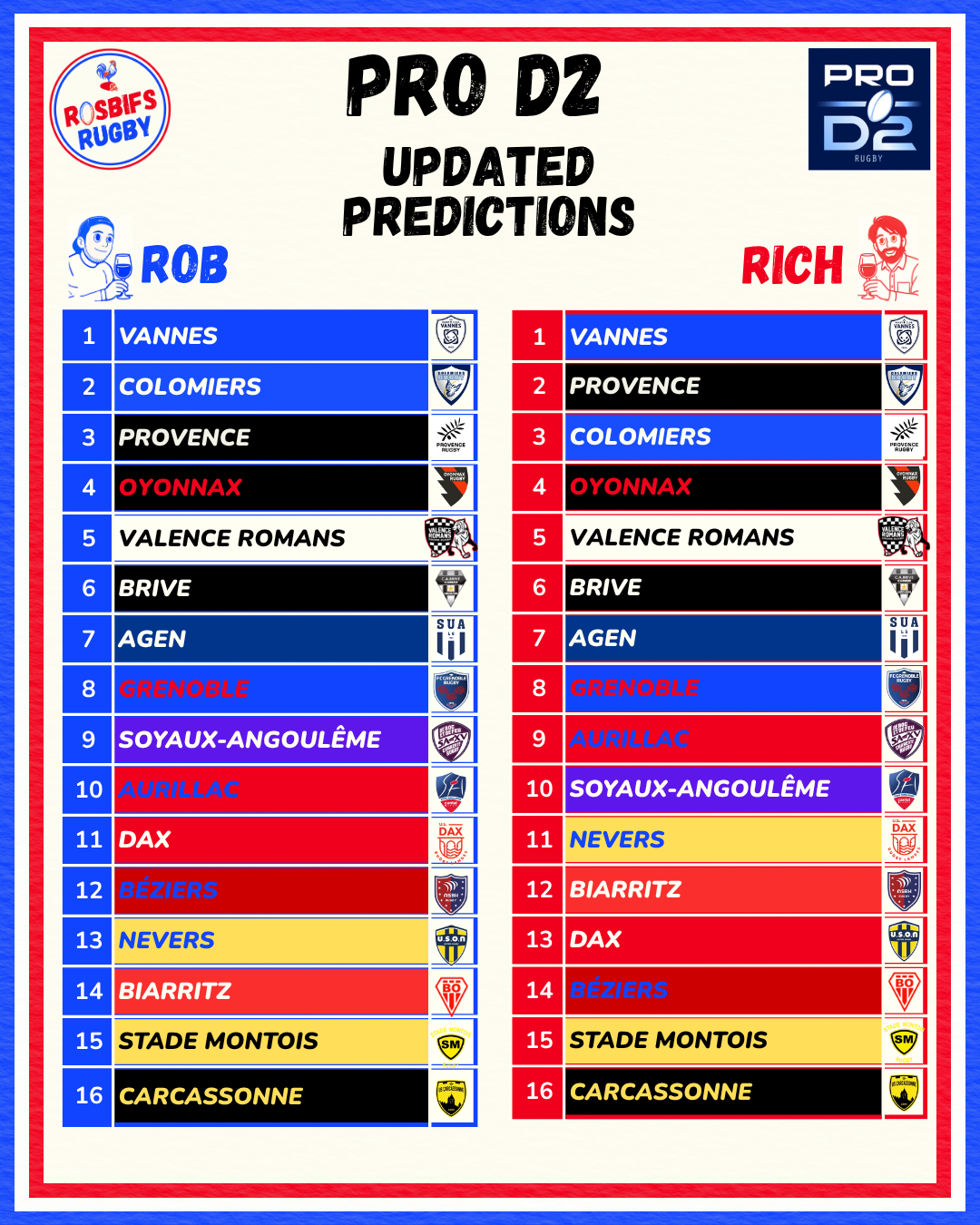
Here is how we think the league table will look come the end of the season:
Rosbifs Rugby is Rob Graham and Rich Croney, two Englishmen (‘Rosbifs’) delivering your one-stop shop for all things French rugby in the English language.