Advertisement



R. Vermaak (41'), S. Jacobs (53'), M. Coetzee (72')
Tries
J. Moorby (13', 18'), C. Taylor (31', 40'), L. Carter (43', 65'), R. Ioane (48'), W. Sititi (76')
C. Bosch (42', 73')
Conversions
B. Barrett (19'), J. Jacomb (40+1', 49', 66', 77')
The Bulls had opportunities to make New Zealand uncomfortable at Loftus. They just couldn't turn enough of them into points.
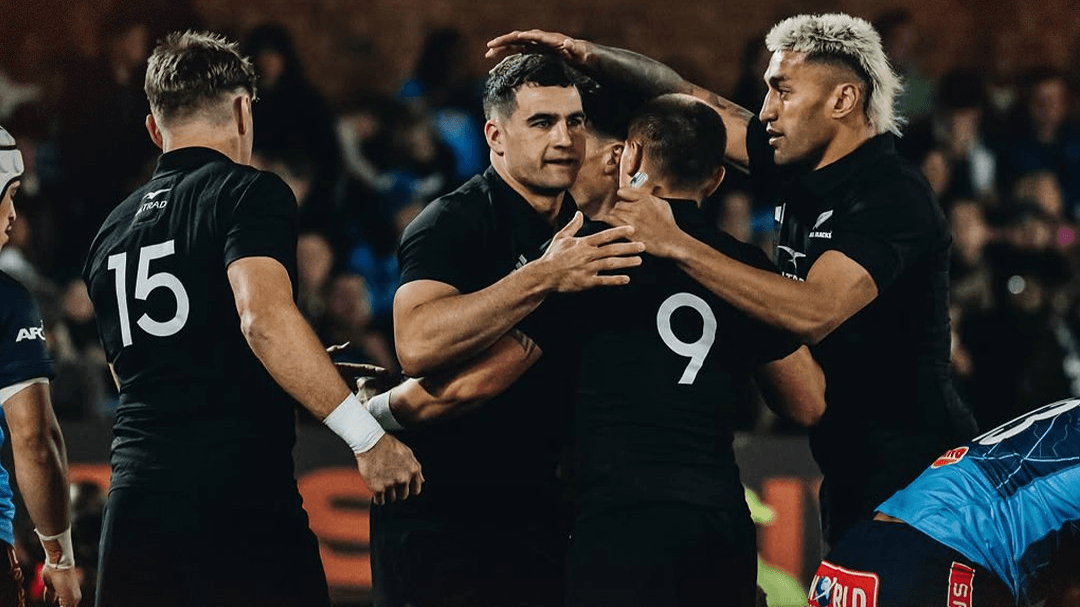
That mattered because at the other end the All Blacks were doing the exact opposite. New Zealand were quicker, more accurate and increasingly dangerous whenever the game became loose, running in eight tries in a 50-19 win that made it three victories from three on their South African tour.
The 24-0 half-time score was harsh on the Bulls in some ways. They had started well, put New Zealand under pressure close to their line and twice thought they had scored, including through Hanro Liebenberg after a chaotic passage sparked by a loose Beauden Barrett offload. Both opportunities disappeared, and that was the difference between the sides for much of the night.
New Zealand didn't need many invitations.
Josh Moorby scored twice in the opening 20 minutes, with his second showing exactly what the Bulls were struggling to deal with. New Zealand regathered a Barrett high ball, kept the attack alive and moved the Bulls around before Peter Lakai put Moorby away. It was fast without being frantic.
Once the All Blacks started winning the collisions and penalties as well, the Bulls were in trouble.
Josh Jacomb's 50:22 gave New Zealand another entry into the 22 and the pressure eventually ended with Codie Taylor taking a quick tap and powering over. The All Blacks captain added another on the stroke of half-time to make it four tries and 24 unanswered points.
Taylor's performance was another reminder of the depth New Zealand have available. Back from injury and captaining the side, he was physical around the field, accurate at the set piece and ruthless close to the line.
The Bulls finally got some reward immediately after half-time when Ruan Vermaak powered over, but any suggestion of a comeback lasted about two minutes.
Anton Segner smashed the ball loose from the restart, New Zealand went straight back onto the attack and Leroy Carter finished in the corner.
That became the pattern.
The Bulls could hurt New Zealand when they got their big carriers involved and Jeandre Rudolph was excellent at the breakdown, winning three turnovers in his hour on the field. Their second try was probably their best moment of the match, Rudolph breaking from halfway before Curwin Bosch released Stravino Jacobs to finish. Marcell Coetzee added a third late on. ?cite?turn2view0?turn2news8?
But the Bulls were constantly being asked to defend again.
New Zealand's speed between phases caused problems all night. Their support runners were arriving early, the offloading game started to open holes and they were comfortable attacking width when the Bulls defence narrowed. Rieko Ioane crossed after more quick handling, Carter finished a second and Wallace Sititi eventually brought up 50.
There was plenty to like about Josh Jacomb as well. Starting at fly-half in an All Blacks jersey for the first time, he didn't look overwhelmed by the occasion. His kicking gave New Zealand field position, including that excellent first-half 50:22, while he looked comfortable directing a backline containing Barrett, Ioane and Anton Lienert-Brown.
The wider context is important.
The Bulls are still in pre-season and were playing their first match since losing the URC final to Leinster on 19 June. New Zealand are operating at a completely different point in their season, and none of the three South African franchises they have faced so far have been at full strength.
So beating the Stormers 38-21, Sharks 54-0 and Bulls 50-19 doesn't suddenly tell us that New Zealand are ready to dominate the Springboks.
What it does tell us is that they are getting sharper.
This was probably their most complete attacking performance of the tour. The Bulls had enough possession and enough moments to expose a few areas New Zealand will want to tighten up, particularly close to their own line, but they couldn't cope consistently with the pace once the All Blacks started moving the ball.
Next Saturday at Ellis Park, the space will be smaller, the collisions much harder and the punishment for mistakes far greater.
That's when we'll find out how much these three wins have actually prepared New Zealand for what is coming.