Advertisement

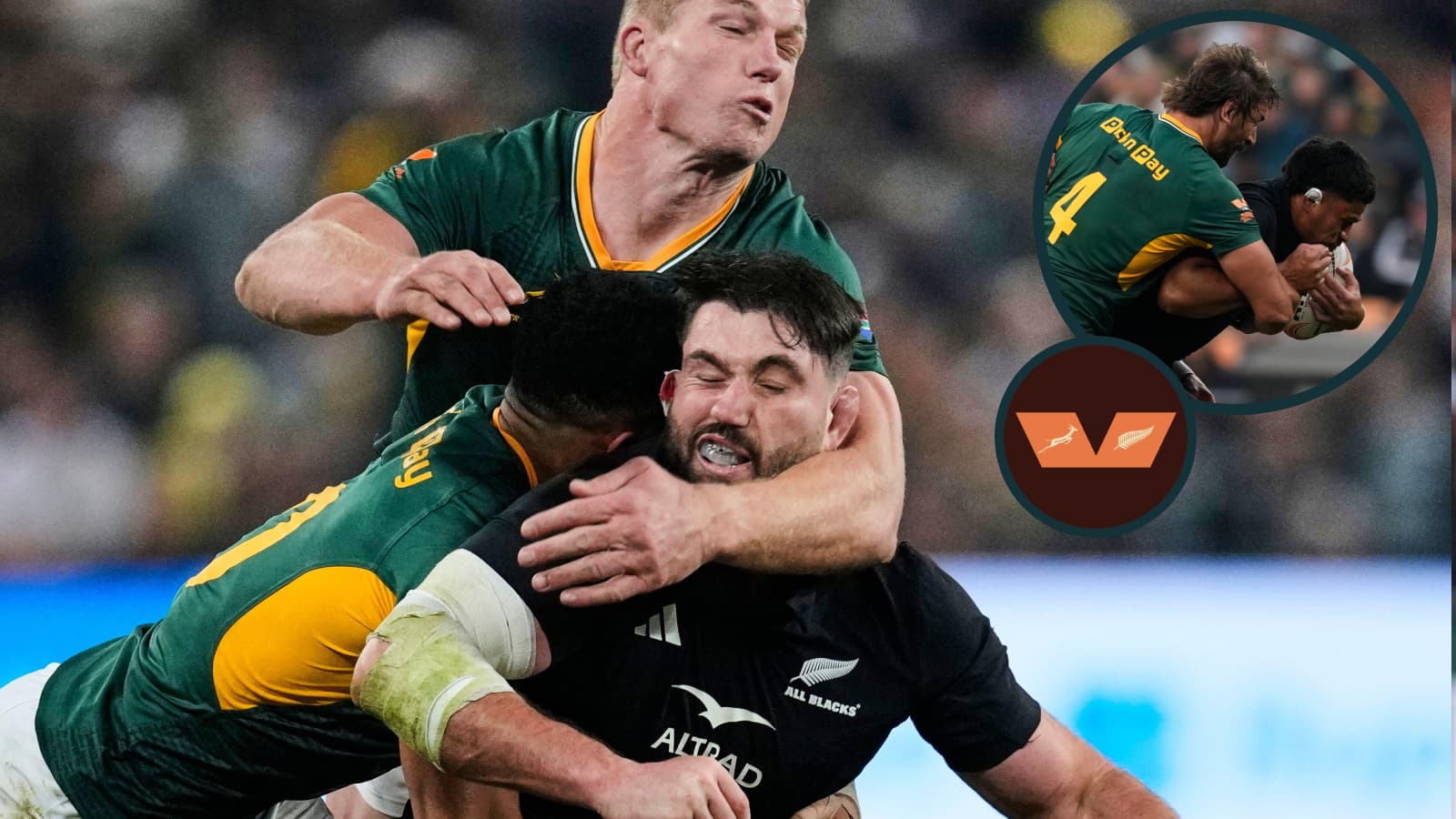
Following an epic contest in Soweto on Saturday, here are our five takeaways from the Springboks' deserved 29-24 victory over the All Blacks in Rugby's Greatest Rivalry at FNB Stadium.
What a feast of rich entertainment this was. The result will go into the books with just five points separating the sides at full-time, but this was a comprehensive victory for Rassie Erasmus' Springboks, who have taken the series 2-1 on South African soil, retribution for the outcome of the famed 1996 series won by the All Blacks.
Yes, the rivalry will have an offshore conclusion with both teams flying to the United States of America for the gimmicky, money-grabbing finale next Saturday in Baltimore, but no one can take anything away from what the Springboks achieved here on home ground, turning around a 0-1 deficit from Johannesburg a fortnight ago to take the lead in Soweto following last weekend's leveller in Cape Town.
This latest firework spectacular could have panned out very differently. However, rather than panicking after the All Blacks went 17-12 up with Will Jordan's unconverted 56th-minute try, they hit back irresistibly from the restart.
Jesse Kriel swatted aside Leroy Carter to gallop from distance for the converted try that secured them the lead for the first time… and they impressively built on this advantage, even producing an emphatic 66th-minute maul try that finished up under the posts with Malcolm Marx touching down.
It was an incredible show of force, a 17-point riposte to create the 29-17 cushion that would have been the full-time score but for Samisoni Tauke'iaho's clock in the red consolation.
The savage encounter had been deadlocked 12-all at the interval, with the brilliant Ardie Savea's two tries getting matched by efforts from Kurt-Lee Arendse and a penalty try off a rumbustious scrum onslaught. There were also big injury casualties on either side, with Savea following the broken jawed Cheslin Kolbe to the sidelines with a damaged shoulder.
And there were also a pair of yellow cards, Sacha Feinberg-Mngomezulu getting punished for a deliberate knock-on and Ruben Love then paying the same price for his chicanery when the hosts were looking to finish off an exquisite move featuring a Jasper Wiese bust, sweet hands from Ox Nche and then wheels from Manie Libbok.
It was beautiful but exhausting to watch, and it thankfully spilt over into an enthralling second-half where the drama reached fever pitch when Kriel's run ignited a stunning turnaround just when it seemed that the All Blacks, despite their wonky scrum, had taken a vital step towards glory.
They hadn't! Instead, Jordan's lead-grabbing try only poked the Boks and their ferocious Greatest Rivalry response will live long in the memory.
With so much focus on the inflammatory scrum spat coming out of last weekend's series leveller at the DHL Stadium, the Springboks' malfunctioning bomb squad in this series escaped quite a bit of heat.
The hosts had led 13-12 at Ellis Park in the tour opener, going on to lose 16-33 after their bench failed to bring the energy, and while they hit back on the Cape with a victory, they were left clinging onto a 24-14 interval lead, getting outscored 9-12 in another second period where their much vaunted replacements failed to deliver.
Erasmus mentioned during the third Test build-up how he hoped his team wouldn't be left punch-drunk coming down the finishing straight in Soweto, and he would have ultimately been left thrilled by what transpired.
New Zealand's lead-taking opportunism should have generated angst and resulted in nerves emerging with the Boks trailing by five with 24 minutes remaining. Instead, we were given a sharp 17-point prod that the cattle which South Africa have at their disposal should never be underestimated.
Yes, there was plenty of solo innovation in the score that immediately changed the scoreboard outlook, with Deon Fourie, Gerhard Steenekamp and Lood de Jager only freshly introduced on a rescue mission.
Kriel's pawning off of Carter and then his production of a Usain Bolt in his prime impression to sprint all the way to the line was a one-man show, but the way the bench then shored everything up and ensured the Springboks decisively took command was impressive, especially the way it manhandled the All Blacks when winning a scrum penalty and then mauling to the line off the resulting lineout.
That was powerful grunt work, the sort that is the envy of the rugby world with 13 months to go before the start of the 2027 Rugby World Cup in Australia.
Maybe Kiwi boss Dave Rennie was onto something when he ruffled Erasmus post-game last weekend in Cape Town with his allegation that the Springboks illegally 'walk around' at the scrum. There we were, salivating over the devastating power of the South African scrum in Soweto when Georgian referee Nika Amashukeli produced a 52nd-minute bolt from the blue.
A scrum on 50 minutes, with the sub All Blacks props having just arrived, had ended with the Boks winning a penalty but, just two minutes later with Thomas du Toit newly introduced, Amashukeli was now drawing a very different conclusion, and it could have had serious consequences for the headspace of the hosts.
The referee decided that the Springboks were suddenly 'walking around, stepping in', much to their shock, and it left Love with a penalty kick to break the 12-all stalemate that had carried over from the interval. The New Zealand fly-half was wide to the right with his kick, and it was a bad miss as the concession of three penalty points would have seriously annoyed the previously dominant Boks scrum.
There were six minutes gone at the FNB when the packs first collided, the 892kg All Black scrum comfortably coming away with ball from their initial clash with their 924kg adversary.
The same happened seven minutes later, the Boks opting to only put in seven players and keep Pieter-Steph du Toit out when defending at the set-piece following Feinberg-Mngomezulu's yellow, but the real disparity between the front rows eventually emerged in the 15th minute when the Springboks won a penalty on their first scrum feed.
That was a perfect indication of the punishment to come, culminating in the salacious show of force just before the break when Amashukeli was left with no other option but to run to the posts and award a penalty try.
The follow-up 'walking around' infringement could have doused Springbok fire when it happened in the second half, but it instead had the opposite effect and the power at the scrum in lead-up to the Marx maul try was electric.
Sticking with All Blacks boss Rennie and his determination to stick his neck out, it was a ballsy call on his behalf to drop veteran hooker Codie Taylor and instead promote Asafo Aumua, not only to try and stabilise the wobbling scrum but also to bring improvement to the other set-piece.
The lineout had certainly been a bone of contention for the head coach's critics, and his decision to axe his centurion front-rower was quite the headline-grabbing gamble.
It worked to the extent that New Zealand drove away from Soweto with an improved 92 per cent success rate, up from 79 in Johannesburg and 83 in Cape Town. However, here's the sting: the one throw missed out of the dozen they had proved incredibly costly.
Aumua has begun well, even executing underhand throws to a non-jumper at the front in order to get the ball away from the contest in two of their first three lineouts, and he also aced the target when throwing into the five-metre lineout that laid the foundation for Savea's opening try on 11 minutes.
However, he faltered in a less pressurised area of the field, seeing a throw around the halfway line pilfered, and the move that materialised from this stolen ball ended with Kurt-Lee Arendse getting in at the corner on 21 minutes. That hurt.
The one statistic that could annoy Erasmus following his team's stellar success was that the late consolation score the Springboks gave up left the third Test try count level at four-all.
Having been eclipsed one-five and three-four on the try counts in the previous games, it would have been an added feather to his cap to turn around this statistic, but it ultimately wasn't to be.
A separate levelled-up stat should be a source of pride, though: the one-all yellow card count. The sin bin had previously hurt the Boks, as two players seeing yellow in Johannesburg and another in Cape Town hurt them coming down the finishing straight, but they were more resourceful when handling that adverse situation here when it happened at an earlier juncture in the match.
Just seven points were conceded when Feinberg-Mngomezulu missed 10 early minutes due to his carded infringement and while the score was 0-0 during the 10 minutes South Africa were a man up with Love in the bin, this wasn't an evening when card play was a black mark against Erasmus' charges.
On another evening, they could well have even been favoured in this score. With the clock stopped just two minutes 29 seconds into the match, assistant Angus Gardner recommended that the referee review Quinn Tupaea's collision with Feinberg-Mngomezulu. He did, but the conclusion was penalty only.