Advertisement

Leinster are having their worst ever URC season. The 5th iteration of the cross-hemisphere competition is seeing the Dublin based side post their worst underlying numbers to date and they have already lost their joint ever most games in a single season after just 13 games.
So what has caused this dramatic drop-off in performance? Should Leo Cullen be under pressure for his job, or is it all Jacques Nienaber’s fault? In this article we will deep did the stats and speak to people who know Leinster best to answer the question: Do Leinster Suck Now?
First of all, it is important to say that an all-time-bad Leinster are still, at worst, the 5th best team in the URC. After 13 games, the only teams who have won more games than Leinster are Glasgow and Stormers, and they have won every game of their European campaign so far.
However, it would be unfair to hold Leinster to the same standards as anyone else in the league. This is partially due to the vast resources Leinster enjoy compared to the majority of their opposition and partially due to the historic success of the province.
Leinster have lost two or fewer games in the entire URC regular season for three of the five tournaments so far. Last year they walked the league, posting some of the most impressive underlying statistics of any club side anywhere in the world.
Leinster themselves make no secret of the fact their target every season is to win the Champions Cup. Therefore, we must judge them against the standard of being arguably the best club side in the world - the URC’s answer to Toulouse or the Crusaders. This season, they are not hitting those heights.
Experienced Leinster journalist Avril Kinsella admits their season has underwhelmed so far: “It’s been a mixed bag. There’s been some really great performances like La Rochelle, and some lower performances… you never know what Leinster team is going to turn up, even though we have the quality there.”
Rugby author Pat McCarry agrees: “I think the Scarlets game sums up Leinster’s season; they’re taking ages to get going and you’re just waiting from them to hit that groove we all know about. You look at the final score and think it was a comfortable game, but they struggled again with discipline and only scored when the Scarlets were down to 13… they just haven’t hit the groove yet this season. Maybe they’ll do it over the coming weeks, but as of now there may be a few reasons to worry - we haven’t seen the Leinster of old.”
After the victory against the Scarlets, Cullen was directly asked if he was happy with how performance were trending. “If you asked me me after the first 4 rounds, where we lost 3 games, I’d be happier with where we are now… We are where we are.”
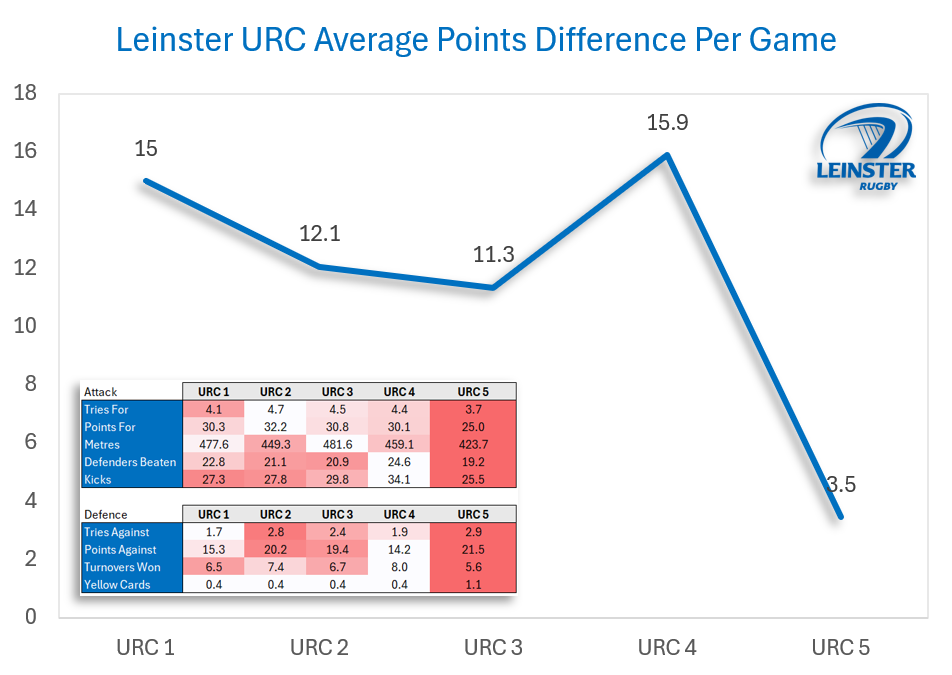
What exactly is wrong with Leinster? Let’s start with their attack: After 13 rounds of the URC, Leinster’s average tries score per game was 3.7, the first time in the URC era the average has dipped below four. Their points per game show an equivalent drop off, going from 32 a couple of years ago to 25 this term.
There are still some positive statistics, such as the fact Leinster have the 3rd best gainline success in the league along with being 4th best for drawing at least two defenders, 3rd most likely to play wider than 20 metres and 4th most likely to retain the ball beyond five phases. Their lineout is also very strong, having the best success on their own throws in the league whilst also having the 3rd most steals and the 3rd best tries per driving maul.
Leinster’s attack does also appear to be showing more ambition and a greater willingness to take risks. For instance, against the Scarlets, Leinster launch multiple attacks from inside their own half. They are one of the most likely teams in the URC to play beyond five phases and play wider than the 20+ metres.
Star winger Tommy O’Brien confirmed that an expansive attack is higher on Leinster’s agenda than it used to be: “We’re always talking about trying to attack the space, no matter where it is. Making sure we identify where it is and how best to attack it.”
However, there are a number of metrics that stand out as being poor. Leinster have the 3rd worst tackle evasion in the URC and are beating nearly five and a half fewer defenders per 80 than they were last season. Their number of kicks per game has also dropped significantly this season, going from 34 last year to 26 this term. Their most evasive player has been Tommy O’Brien, who has started just two URC games so far.
Then there is the question of perception. As URC fans, we are used to seeing Leinster blow away their opposition. Particularly in Champions Cup games we expect that star studded squad - often jokingly referred to as ‘Ireland but blue’ to steamroller the sides they face sight up until the semi-finals.
However, the stats reveal that Leinster score 63% of their tries in the second half. When you factor in the fact Leinster’s total tries have dropped, we start to understand why Leinster feel so underwhelming this season; we expect them to be out of sight by half time, but it is actually taking them well over an hour to make most games safe.
We’re also not seeing their star players really spark like we expect. Leinster’s top players for try involvements per 80 this season are Josh van der Flier and RG Snyman, no Leinster player ranks in the European top 30 for this statistic and just one Leinster back registers in the top 40 - the excellent but relatively unheralded Joshua Kenny. This again plays into the perception issue: Leinster have all these star players, but none of them a really generating those highlight reel moments that you expect.
Whilst the attack is uninspiring, the aspect of Leinster’s game that has arguably declined the most compared to 12 months ago is the defence. Last season, Jacques Nienaber masterminded a world class defensive record. In an era where try scoring in rugby union is through the roof, Leinster averaged just 1.9 tries conceded per 80 - a phenomenal achievement.
However, this season, they are falling well short of that same standard. Leinster still have the best gainline denial of any side in the URC but their tries conceded per 80 has risen by one whole try to 2.9, with points conceded rising from an average of 14.2 to 21.5. Coupled with Leinster’s drop off in points scoring, their average margin per game has dropped by nearly 80% since last season - from 15.9 points to 3.5. It’s still a positive record, but it is a relatively huge drop-off.
There are two stand out statistics which suggest reasons for why Leinster’s defence has become much less effective. Firstly, their average turnovers won per game has dropped from 8 down to 5.6, the first time Leinster have averaged fewer than six turnovers won per game in the URC era.
When asked about the performance of Leinster’s defence, head coach Leo Cullen admitted “We’re not exactly where we would like to be, but that’s on both sides of the ball. When we get cohesion with the group, that will be a big part of that [fix}.”
A much bigger problem, however, is discipline. In the first four iterations of the URC Leinster picked up 8 yellow cards every single season. In 2025/26, however, they already have 14 yellow cards in just 13 games. In relative terms, this means their yellow card rate has more than doubled.
“The big thing for me has been the yellow cards.” say Kinsella, “I think we’re almost double last season already - there were three in the Glasgow game alone, which is very un-typical of Leinster.”
Even more concerning is that their total number of penalties has not significantly increased, meaning the penalties they are giving away are far more costly than they have been to date. For example, Munster have conceded just one fewer penalties than Leinster this season but received less than half the number of yellow cards.
When pushed for reasons for the sudden drop in performances this year, most Leinster fans will be saying the same thing: “we are suffering from having all our best players picked for the Lions”. They are, of course, completely correct - but not for the reason you might be thinking.
Leinster broke the record for most British & Irish Lions selected from a single club by having 12 named in the squad for the 2025 tour of Australia. The tour lasted right up until August and saw 10 games played in a little over five weeks. Lions tours are historically renowned for casting a long shadow both physically and mentally on those who participate.
No one is more cognisant of the Lions hangover than Leo Cullen, who said: “If you look at the amount of minutes our test players have played, you’ll see why we’ve had to use such a high amount of players this season so far. It was great to see 12 or more Leinster players on a Lions tour, which is pretty much unheard of.”
Kinsella further outlined the impact the Lions has had on the Leinster squad: “I would say from the statistics, it is very rare a British or Irish team wins the Six Nations after a Lions year. I definitely think there’s a hangover - I remember seeing Tommy Freeman talk about how exhausted he was after it. The Leinster players might not think they are feeling it, but I definitely think it’s there. The season has asked a lot of them.”
McCarry confirmed the strain has been felt by the squad: “Leo Cullen has mentioned how many guys have been off on Lions duty and international duty… Definitely, at the start of the season, it was tough with managing minutes. In November, Andy Farrell was selecting players who hadn’t played a club game yet this season - that’s how mad it was after the Lions tour.”
However, the fact is that Leinster do not have 12 knackered rugby players running around the pitch every week. The Irish provinces are known for their rigid player rest policies which sees top Irish stats game-time managed much more strictly than their British and French counterparts. Hence, the team we have mostly seen pull on a Leinster jersey in the URC this season has usually been some way short of their strongest possible lineup.
This is nothing new, of course, Leinster fielding a B team in the URC has become a cliche to the point where URC detractors use it as a stick to beat the whole league with. However, even by Leinster standards, the 2025/26 season has taken this concept to its extreme.
Cullen defended his selections, saying: “We haven’t had that much availability from a pool of players, so it’s been a bit of a challenge in terms of cohesion and consistency of performance. We’re finding a way through it and we’ve been battling through different phases.”
However, are these challenges starting to become selt inflicted? Leinster are currently averaging over 10 changes to the starting XV every URC game this season and have changed at least 9 player in 10 out of the first 13 games so far. Leo Cullen has selected at least five different players to start in 8 of the 15 positions this season and at least four players in every position except the half-backs. Any team in the world, no matter how good their structures and processes, would be somewhat held back by this level of churn.
At this point, it is worth questioning Ireland’s uber-strict player resting policies. Firstly, it isn’t actually yielding better results. The Irish Times recently tried to argue superior player resting would help the Irish clubs overcome the French clubs in the latter stages of the Champions Cup, even though it absolutely has not helped in any of the past four seasons.
McCarry conceded the chopping and changing of selection is holding the team back: “It’s just that cohesion they’re lacking. Even someone like Hugo Keenan, who mightn’t play that much, he can come in a steady the ship. The Harry Byrne/Sam Predergast thing - who is top dog? Who does Leo trust? Who do you pick in the centres? Leo has also mentioned players going from the Ireland system back to the Leinster system. It’s a combination of a few things.”
“You wonder: is the team we saw against Scarlets now going to be the bulk of what we see for the rest of the season? We are seeing some players come back we maybe didn’t expect - like Ryan Baird for example, we thought his season might be done.”
Secondly, it isn’t actually stopping players from getting injured. Captain Caolon Doris missed the Lions tour through injury whilst Andrew Porter, Tadhg Furlong, Dan Sheehan, James Ryan, Joe McCarthy, Robbie Henshaw, Garry Ringrose and James Lowe have all missed significant game time over the last 12 months due to injury. Fullback Hugo Keenan has struggled desperately for an injury free run, despite playing literally half the number of games as French counterpart Thomas Ramos.
Despite the issues it has caused, most people in Dublin still back the rotation policy: “I think it is a good thing,” argues Kinsella, “We get to see so much young talent coming through. For instance, someone like JJ Kenny - if he was in any other side I don’t think he would have been in so quickly and having so much experience.
“It helps us when we pick up injuries too - we now know we have players to call on and squad depth that we can rely upon… Sometimes you look at the players and you’re amazed at how young they are, yet they have the experience. Because of the Leinster system, which they’ve been in all of their lives, they are well aware of what is required. I think it’s really exciting.”
Even so, the excuse of player management still doesn’t fully explain the drop in performances. The teams that started against the Stormers in round one and Glasgow in round 13 were, on paper, far superior to their opposition in terms of the reputations of the players. However, they were well beaten in both games. We must, therefore, conclude that Leinster are less than the sum of their parts.
Furthermore, Leinster don’t actually supply as many players to the Ireland first team as they used to. They may be in the squad, but the 2026 Six Nations saw a far greater mix of players from other provinces selected by Andy Farrell. Arguably, at least three of Ireland’s top performers this Six Nations.
When it comes to individual players, there are two names who have been the focus of most of the criticism. First, there is star signing and All Blacks centre Rieko Ioane, who has failed to live up to the legacy of his predecessor Jordie Barrett.
“He (Ioane) has been ok, the story seems to be about him for some reason. he hasn’t lit the world on fire, but I don’t think he was doing that in New Zealand either. he came out like a train at the start of his career with the All Blacks, and then became more combative and defensive.
“I think the difference is Jordie Barrett was a real leader, you could see him coaching his teammates on the pitch. Whereas, Ioane is more looking after his own thing. Maybe that’s something you need to look at when you are that kind of money on a player. Imagine they get to the end of the season and Ioane is on the bench - Cullen won’t be afraid to make a decision like that.”
Kinsella concurs that the Jordie Barret comparison, whilst natural, is unfairly hurting Ioane: “I think people were expecting Rieko to be Jordie Barrett 2.0, but he was never that player. I don’t think it was fair to have that expectation of him. I think he’s been solid, I wouldn’t say anything particularly negative about him, but when you sign someone like that people expect much more. I think he’s been decent.”
Second, we cannot ignore the noise surrounding fly-half Sam Prendergast. An oversimplified view says that, of the six games where Sam Prendergast has started for Leinster, they have won just two. This statistic lacks context and nuance, but it sums up why the debates exist in the first place.
The arguments around Prendergast have been done to death, and at times turned toxic. Kinsella expressed her frustration at the nature of the debate: “I hate hate this out-half debate. I think they’re so different, they all have different positives and negatives. It depends what game plan you want, it’s really unfair to say one is better than the other. Some people say Sam has a more X-factor and a higher ceiling, but he’s also incredibly young. Harry has improved so much since he came back.”
McCarry pointed out that number 10 is not the only jersey where it' is unclear who the first choice players are: “The Harry Byrne/Sam Predergast thing - who is top dog? Who does Leo trust? Who do you pick in the centres? Leo has also mentioned players going from the Ireland system back to the Leinster system. It’s a combination of a few things.”
Have we now proved that Leinster’s time as a top club has ended? No, of course not. They are still on track to achieve top 4 in the URC and should at least get to the semifinals. They should also progress to a similar point in the Champions Cup. Furthermore, the thing that Leinster have always been criticised for is peaking at the wrong part of the season and falling apart when it matters. What if, this season, they are underwhelming when it least matters and are aiming to peak come knock-outs time? If they do, people will forget how they get there and remember only that they won.
“You’d always be confident in the URC.” says McCarry “Even when they lost three out of the first four, you always expected them to punch their way back into it. After the loss against Munster, everything was on it’s head, but they’ve clawed their way back since then.
“They might have to do it the hard way by going away from home, but they’ll definitely be in the mix. In Europe, maybe the likes of Toulouse and Bordeaux will scare them a little bit. Fans will be confident, but they’ll want to see them clicking a little bit better first.”
Kinsella agrees: “Having players coming back, I think it’s when things start coming together. I always try to be positive! I think it has been a really interesting season, even if we don’t win silverware (my logical brain says I don’t think we will) we have still brought through a lot of exciting talent.”
The talent is the salient point. As the old saying goes: from is temporary, class is permanent. There is simply too much talent in the building for Leinster to truly drop off a cliff, even with the IRFU working in the background to redistribute that talent more evenly amongst the other provinces.The rest of us should enjoy Leinster’s struggles while we can - they won’t last for long.