Advertisement



K. Arendse (21'), Penalty Try (37'), J. Kriel (58'), M. Marx (66')
Tries
A. Savea (11', 26'), W. Jordan (56'), S. Taukei'aho (80')
S. Mngomenzulu (59', 67')
Conversions
R. Love (12'), D. McKenzie (80')
S. Feinberg-Mngomezulu (71')
Penalties
This one said more about control than chaos. At altitude, with the series tied and the margin for error tiny, South Africa won because they were ruthless in the red zone and handled the game’s mood swings better. New Zealand had more ball, more line breaks and stretched the field, but the Boks banked seven-pointers when the door opened and kicked calmly to make it a two-score game late. That’s why they leave Soweto ahead.
The numbers back it up without telling the whole story. New Zealand carried more and broke more; South Africa didn’t blink at the set piece and took points when field position and discipline flipped their way. Add the bench punch and a hard, tidy lineout, and you have a five-point Test that felt like two until the last play.
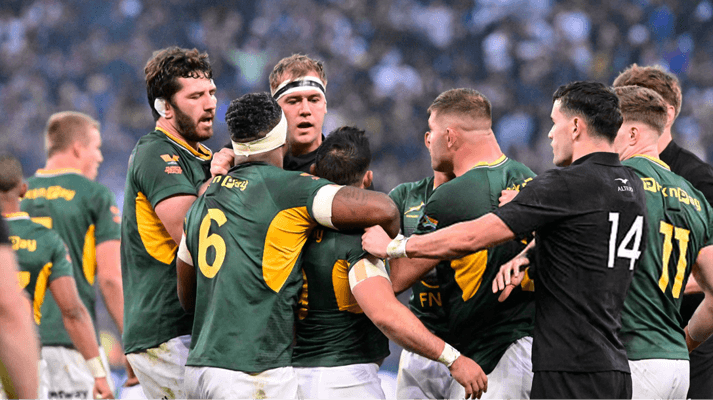
The turn came before half-time. Two early tries from Ardie Savea had the All Blacks in front and asking questions, but a yellow to Ruben Love and the immediate penalty try swung the ledger. It wasn’t pretty; it didn’t need to be. With a man up, South Africa turned pressure into an automatic seven and dragged the contest back to attrition rather than tempo. From there, New Zealand were chasing the whole evening, even when they briefly wrestled back the lead.
New Zealand’s attack did plenty right. They finished with 56 percent possession and 12 clean breaks and found space on the edges, where Will Jordan eventually got his reward after the break. Jordie Barrett tackled his lungs out in the 12 channel and Peter Lakai carried with punch. But the Boks’ scramble held, their maul and entry play were tidy, and every All Black incursion demanded three or four visits to come away with five. That’s how 29–24 happens when the running metrics say otherwise.
Look at the set piece and you see why South Africa never panicked. Both sides were perfect on their own scrum feeds, but the Boks went 12 from 12 at the lineout and lived off the clean ball that gives their phase shape meaning. When the game tightened, they had the platform to exit or to reload, and in the third quarter they did both.
Individuals mattered. Kurt-Lee Arendse took the first South African try with his usual economy of movement, Jesse Kriel hit the outside lane to level things up just as Jordan had stung them, and Malcolm Marx did what Malcolm Marx does: arrive at the business end and make it count, smashing over in the 66th minute to put daylight on the board. After an edgy start that included a 10th-minute yellow, Sacha Mngomenzulu steadied, nailed two conversions and, crucially, took the points on 71 minutes. That penalty was a selection of good Test-match habits in one kick: scoreboard pressure, composure, and respect for the clock at altitude.
The All Black bench had a say too. Samisoni Taukei’aho finished at the death to pry the gap back to one score, but by then the damage had been done. South Africa had already made it a two-score challenge, and New Zealand had burned too many phases for too little return through the middle hour to threaten a steal.
Does the margin flatter anyone? Not really. The late New Zealand try narrows the optics, but the Boks had earned that buffer with a clinical 10-minute period around Marx’s try and Mngomenzulu’s penalty. Equally, 29 is not a hiding; it’s what you get when one team is cleaner at the lineout and colder in the 22 while the other spends more time playing but can’t turn 50/50s into sevens. If there’s a caveat for South Africa, it’s the 32 missed tackles. They bent a lot. You don’t want to live that way for long stretches against this All Black back three.
Discipline is the All Blacks’ big review note. Twelve penalties and a yellow that immediately became a penalty try is a gift you can’t afford in Johannesburg. The red-zone conversion rate wasn’t good enough for a side that actually won the gain-line more often than the scoreboard suggests; they’ll look hard at how they managed advantage and ruck speed once the Boks tightened their spacing. The pack changes – Asafo Aumua starting, Sam Darry in the row – didn’t cost them the set piece, but they didn’t sap South African legs either. That’s the standard now: parity isn’t enough.
South Africa will be satisfied with the balance. Perfect lineout, a bench that shifted momentum, and a 10 who reset after an early card to close the game out. The work-ons are clear: shore up the edge defence and tidy the tackle count, because Baltimore will move faster. New Zealand take belief from the territory and the breaks, but must cash them in and cut the avoidable infringements. The series moves to the States with the Boks holding the rope and the All Blacks needing accuracy, not just ambition, to haul them back.