Advertisement

France defeated Scotland in the Guinness Men’s Six Nations to wrap the 2026 title with a game to spare. In a tournament known for it’s closeness and unpredictably, a second consecutive championship has looked theirs to lose ever since they went 22-0 up at half time in their opening match against Ireland.
This has been one of, if not the, most complete conquest the Men’s Six Nations has seen for years. What makes it even more scary, though, is that if we go past the eye test and deep dive the statistics, we see that France’s domination was even more complete than any of us could have realised.
France’s 2026 Six Nations victory will be remembered for some of the most glamorous attacking rugby the tournament has ever seen. After the first 3 rounds of the championship France were comfortably top of every major attacking stat with a significant gap to the next best team:
Tries Scored (+50%)
Carries (+7%)
Offloads (+124%)
Defenders Beaten (+33%)
Metres carried (+32%)
Initial breaks (+41%)
Metres per carry (+23%)
Their offloading total in particular, having made more than double what any other team have managed, underlines just how fluid and attractive to watch this France attack has been. Furthermore, they were beating an average of 15 defenders more per game than they were in 2025.
The flair has been backed up with lethality, too: According to Opta, France outperformed the average 22m conversion rate in all 3 of their opening matches. The stats also reveal that, in the first 3 rounds, France scored 8 tries that originated in their own half - more than every other team combined. The same goes for tries from kick return, where they had scored 8 compared to everyone else’s 3, and tries on 1st phase where their total of 9 was almost twice as good as the next best team’s 5.
Naturally, the biggest reason for their attack being so good is the sheer talent in their squad. Nowhere better illustrates this than in the centres; after the first match against Ireland, France lost both of their first choice centres - the UBB pairing of Yoram Moefana and Nicholas Depoortere - to injury.
Facing what would have been a disaster for almost any other nation, France simply subbed in the Pau pairing of Fabien Brau-Boirie and Emilien Gailleton - who at the time had a combined 6 international starts and a combined aged of just 42. The pair of them have slotted in seamlessly.
Elsewhere, the ferocious excellence of Antoine Dupont and Louis -Bielle-Biarrey is well know and both have maintained their world leading performances this tournament. Meanwhile Theo Attissogbe has proven Fabien Galthie was right to select him over Damien Penaud, with his work in the air being a particular stand out.
The real secret to France’s backline, however, is how fly-half Matthieu Jalibert and fullback Thomas Ramos have combined their individual brilliance into a partnership that is simply unplayable. Together with Dupont, they have formed an alliance in what the French are calling ‘Le charnière tois’ (the half-back 3).
There appears to have been a concerted effort from not only Dupont but also Ramos to finally make a Jalibert partnership work in blue and the result have been devastating. After the first 3 rounds, Jalibert and Ramos were 1 and 2 for both offloads and line break assists. By using both men as playmakers, not only are France getting the best out of them individually but they are also getting the best out of their teammates.
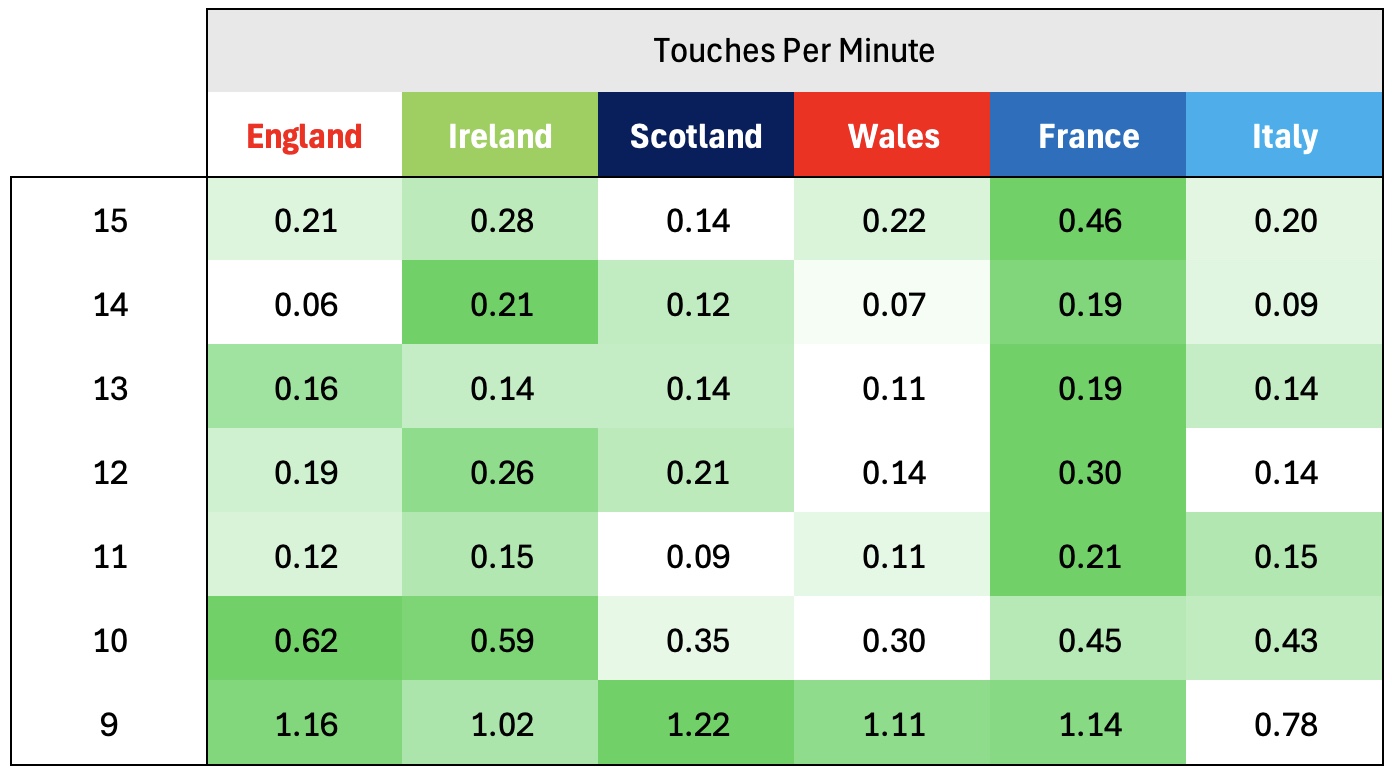
The below graph shows touches per minute from the first round of the tournament. It reveals that not only did France’s backline touch the more more frequently than any other side but that those touches were far more evenly distributed amongst them. Ramos in particular stands out with almost double the touches per minute of any other fullback. This illustrates how he integral he is to France’s attack.
side note: There had been considerable debate in France about whether Dupont and Jalibert could work together effectively. Even Fabien Galthie didn’t appear convinced for a long time but Romain Ntamack getting injured forced him to give Jalibert an opportunity. We are now seeing his masterclass performances at club level - that earned him the nickname ‘maestro’ - replicated at test level and the whole team is benefitting from it. To be fair to Galthie, his selections for this Six Nations have been spot on; his decisions to drop Damien Penaud, Gregory Alldritt and Gael Fickou have all been vindicated.
When we are distracted by such fluid backs play it is easy to miss that the forward pack in front of them has been by far the most brutal in the tournament. The lock pairing of Guillard and Ollivon may have been arguably the most dynamic of any duo in the world, but they have been backed up by absolute monsters whose physicality has been on another level.
According to the Six Nations website, France made 60 dominant tackles across the first 3 rounds - 76% more than any other side. The same website listed the top 6 players for dominant hits all being French forwards whilst Oscar Jegou ranked in the top 5 for total tackles, dominant tackles and defensive rucks hit. Compared to 2025, France were averaging a massive 9 extra dominant per game.
The result of this massive physical dominance is that, in an era where try scoring in rugby is through the roof, France averaged just 11 points conceded across their first 3 games - their best ever defensive start to a Six Nations campaign. That stat was no doubt help by their phenomenal discipline, with their penalties conceded being the lowest this decade at just 5.7 per game.
side note: what is interesting, though, is that France’s forwards rank far low in the Six Nations for dominant carries, which seems counter intuitive. This is because the pack Galthie is selecting is designed to support the phenomenal attack with link play and skills prioritised over brute force. I recommend this Substack from Sam Larner who explains more about how this works.
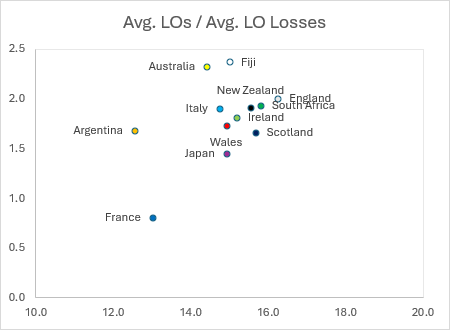
Finally, France’s lineout continues to be comfortably the best in the world. Since the start of 2025, France have averaged less than 1 lineout loss per match - the only tier 1 side to achieve that feat. Across the first 3 rounds they operated at 97% success, losing just 1 across the opening 3 matches.
Finally, the stats that have arguably stood out the most for France this Six Nations are the ones related to kicking. What makes these numbers elite is not only their values but also their variety. France’s kicking game is usually characterised by it’s length, i.e. they tend to kick the longest. That is still the case in 2026 where, across the first 3 rounds, they had the most kick metres and the most metres per kick. France also had the highest number of kicks that bounced, showing their excellence at finding space in the backfield.
But what made France’s kicking stats different this year was their retained kicks. If we look at club rugby stats for this season so far, we see that the French TOP 14 team are usually the least likely to kick contestable. However, France were registering the most retained kicks and the highest percentage of kicks being retained. Compared to 2025, France were box kicking 3 times extra per game and retaining 3 extra kicks.
This shows how they have added an extra dimension to their strategy and now boast the most complete kicking game in the Six Nations. To top it off, they even had the most successful kicks at goal. For more information on the evolution of kick strategy in the Six Nations, check out this article by Opta Analytics: