Advertisement

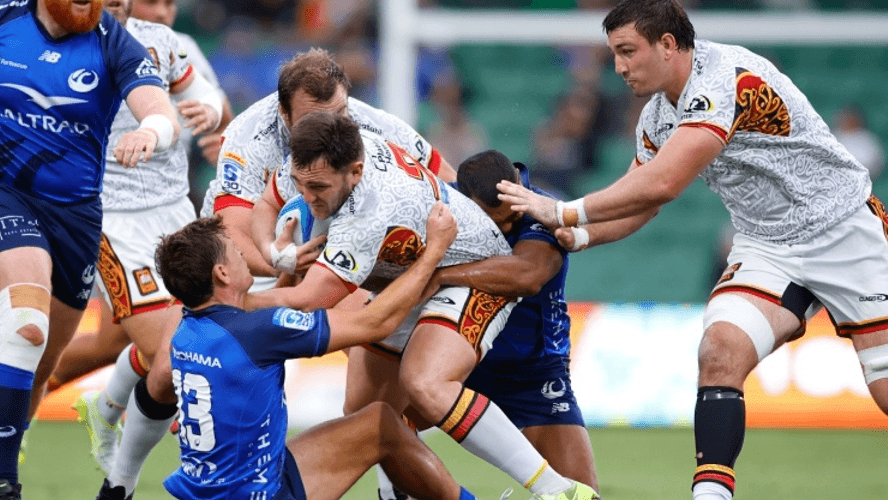
Round 7 of Super Rugby Pacific felt less like a fixture list and more like a group therapy session for teams with commitment issues; the Hurricanes couldn’t stop scoring, the Reds couldn’t stop believing, the Blues treated Eden Park like a personal savings account for bonus points, and somewhere in Perth the Force once again discovered that hope is a dangerous thing to have against a New Zealand side.
Moana Pasifika and the Highlanders took turns trying to lose from winning positions, the Brumbies and Waratahs reprised their usual Canberra drama with one side pretending it was closer than it ever really was, and the Drua spent 80 minutes flickering between unplayable and unrecognisable, often in the space of a single phase.
By the time the lights went out on Saturday night, the only real constants were the Chiefs still treating Perth like a points buffet, Australian sides discovering that hope is not a defensive system, and Kiwi backlines casually rewriting what we thought support lines were supposed to look like.
| # | Team | PL | W | L | D | PD | BP | PTS |
|---|---|---|---|---|---|---|---|---|
| 1 |  Hurricanes Hurricanes | 6 | 5 | 1 | 0 | 166 | 5 | 25 |
| 2 |  Blues Blues | 7 | 5 | 2 | 0 | 95 | 5 | 25 |
| 3 |  Brumbies Brumbies | 7 | 4 | 3 | 0 | 50 | 4 | 20 |
| 4 |  Queensland Reds Queensland Reds | 6 | 4 | 2 | 0 | -18 | 2 | 18 |
| 5 |  Chiefs Chiefs | 6 | 4 | 2 | 0 | 31 | 1 | 17 |
| 6 |  Crusaders Crusaders | 6 | 3 | 3 | 0 | 6 | 2 | 14 |
| 7 |  Waratahs Waratahs | 6 | 3 | 3 | 0 | -15 | 2 | 14 |
| 8 |  Highlanders Highlanders | 7 | 3 | 4 | 0 | -44 | 2 | 14 |
| 9 |  Fijian Drua Fijian Drua | 6 | 2 | 4 | 0 | -57 | 0 | 08 |
| 10 |  Western Force Western Force | 6 | 1 | 5 | 0 | -52 | 0 | 04 |
| 11 |  Moana Pasifika Moana Pasifika | 7 | 1 | 6 | 0 | -162 | 0 | 04 |


N. Jones (43'), M. Sanerivi (52'), A. Craig (57')
Tries
C. Tangitau (7', 27'), J. Nareki (33'), J. Taylor (38'), N. Shearer (40'), V. Lasaqa (51')
J. Garden-Bachop (44', 53')
Conversions
R. Pasitoa (28', 34', 51')
Penalties
R. Pasitoa (20')
Some games are contests, some are statements, and some are just a reminder that certain fixtures still live in one team’s back pocket. Blues 43, Moana Pasifika 7 at Eden Park was very much the third category. For twenty-odd minutes it looked like we might get a proper arm-wrestle when Patrick Pellegrini banged over the conversion to make it 10–7. You could almost convince yourself this was going to behave like a derby. Then Ofa Tu’ungafasi rumbled over a minute later, the Blues jogged into half-time 15–7 up, and the second forty turned into that familiar Eden Park experience.
Beauden Barrett had one of those quietly ruthless evenings that don’t always make highlights but decide games. He missed his first three conversions as the Blues spluttered a little off the tee, then calmly nailed his last four to drag the margin out past respectability and keep the scoreboard aligned with the performance. By the time Mason Tupaea crashed over in the 78th minute, the Blues’ seventh try from their seventh different scorer, it felt less like Moana had been beaten by one or two stars and more like they’d been slowly dismantled by the weight of a squad that knows exactly how to close out this kind of night at home.
In the wider arc of their season, it slots neatly into both teams’ existing storylines. For the Blues, it’s another data point in an Eden Park run that now reads six wins from seven and a defensive record that rarely lets anyone past twenty; this one never even threatened double figures. For Moana Pasifika, it’s a harsh reinforcement of the gap between their best days and their floor. They’ll take heart from how often they got going with ball in hand and how hard players like Tupou Ta’eiloa and Sanerivi keep coming. The Blues will take five log points, a healthy highlights reel and the quiet satisfaction of knowing that, in this particular fixture at least, normal service has very much resumed.


L. Shaw (9', 45'), C. Cale (40+4'), L. Reimer (78')
Tries
C. Halaholo (2'), A. Kellaway (16'), J. Walton (28')
R. Lonergan (10', 40+5', 46'), T. Edmed (78')
Conversions
S. Harvey (3', 17', 29')
Penalties
S. Harvey (65', 69', 73')
Some rivalries sprawl over decades; Brumbies–Waratahs in Canberra tends to compress all of that history into 80 slightly unhinged minutes. On Friday night at GIO Stadium, the script finally flipped. After eight straight defeats in the capital, New South Wales dug in, kicked their goals and survived a late surge to edge home 30–28, pinching a game in which the Brumbies owned the ball but never quite the scoreboard.
The Waratahs, finally, found a way to be pragmatic when it mattered. Their attack in the second half mostly shrank to restarts, counter-punches and Harvey’s metronome. Three penalties between the 66th and 74th minutes, each slotted with the kind of unbothered calm that belied the situation forced the Brumbies into chase mode.
Even the ending refused to behave neatly. Luke Reimer’s 79th-minute try after sustained pressure underlined the Brumbies’ refusal to go quietly, and when Tane Edmed nailed the touchline conversion to drag it back to 30–28, there were just enough seconds left to make every Waratahs supporter in the ground reach for whatever lucky ritual they’d been ignoring for the last ten years. The Brumbies had one more crack, but a handling error under pressure, their 13th turnover of the night, finally killed it, and with it went their eight-game home streak over the old enemy.
In the wash-up, this will be remembered in two very different ways. For the Brumbies, it’s a brutal reminder that volume without ruthlessness is a fragile way to live; more ball, more metres, more carries, more rucks, and still not enough control to keep the scoreboard in line once they got into the red zone. For the Waratahs, it’s the night a flaky narrative bent in their favour, a win built on work-rate, kicking accuracy and a defensive effort that finally matched the ambition of their backline. In a rivalry that has spent a decade telling one story, this felt like a plot twist worth circling in ink


C. Roigard (3'), J. Moorby (14'), F. Fineanganofo (17', 50', 54'), B. Sullivan (27'), W. Dearns (43'), V. Bason (73')
Tries
J. Campbell (6'), I. Henry (36')
R. Love (4', 17', 44', 51', 55', 73')
Conversions
H. McLaughlin-Phillips (7', 37')
Some hoodoos are statistical quirks; the Reds in Wellington have become more of a heritage listing. The last time Queensland won in the capital was 1998, when the Wallabies were prising the Bledisloe Cup out of All Black hands, the iPhone was nearly a decade away from existing, and most of this Hurricanes backline were still figuring out how to make their school First XV. Whatever faint hope Les Kiss’s side brought across the Tasman lasted about as long as the first defensive set at Hnry Stadium, dissolving under 80 minutes of pace, power and a scoreboard that eventually read Hurricanes 52, Reds 14.
For a quarter of the game, the Reds at least pretended the curse might be loosening. They matched the Hurricanes try-for-try early, with Jock Campbell hitting back after Fehi Fineanganofo’s opener and Isaac Henry slicing through later in the half to keep the scoreline to 24–14 at the break.
Once Ruben Love and Cam Roigard settled into their work, the game began to feel horribly familiar for Australian eyes. Du’Plessis Kirifi played like he’d wired himself directly into the stadium lights; 11 carries, 117 metres and 20 tackles in a performance that somehow managed to be both chaos and control. Bailyn Sullivan kept punching holes on the edge, and by the time Vernon Bason rumbled over, the only real mystery left was how bad it was going to look on the scoreboard.
For the Reds, there are crumbs if you’re determined to find them. The work-rate never fell off against the form backline in the competition is not nothing and their bench at least added some punch rather than disappearing into the noise. But the pattern is impossible to ignore; more ball, more effort, and still a night where they conceded eight tries and were outscored 28–0 in the second half. Until they find a way to turn those carries and tackle busts into actual territorial control and pressure on the scoreboard, trips to Wellington will keep feeling like time-travel back to an era where Kiwi sides did whatever they wanted and Australian visitors spent the last 20 minutes wondering how it all got away from them again.


M. Wrampling-Alec (6'), B. Slater (19', 50'), C. Vai (57'), P. Spencer (64'), C. Clarke (80')
Tries
E. Waqa (16'), M. Vocevoce (35')
B. Barrett (6', 20', 51', 65', 81')
Conversions
K. Valetini (17')
Penalties
K. Valetini (43')
Some wins are built, some are chased, and some are just calmly collected after half an hour of feeling like you’ve stumbled into someone else’s festival. For 40 minutes at Eden Park, the Blues looked less like hosts and more like the support act at a Drua party, living off scraps of possession while Fijian carriers tore down the tramlines and the visitors stacked up nearly 900 metres with ball in hand. By full-time, the scoreboard read Blues 40, Fijian Drua 15, and the only festival left was the familiar one; another New Zealand side turning limited ball, sharp moments and a suffocating last quarter into a scoreline that said “comfortable” where the game itself had been anything but.
What made the difference wasn’t volume, it was edge. The Blues finished second in most of the counting stats, less ball, fewer carries, fewer metres, but they were ruthlessly efficient when they did get go-forward. Barrett quietly stitched it all together with 10 points and a 5/6 night off the tee that ensured the scoreboard reflected their purple patches.
The set-piece and defensive temperament did the rest. The Blues won 17 of 18 lineouts and pinched three of the Drua’s, repeatedly stalling their maul platform and forcing them to play from deeper than they’d like. Sam Darry and Josh Beehre were central to that, combining for 32 tackles and a lineout steal apiece, while Anton Segner and Pita Ahki got through 33 tackles between them in the tight channels. The Drua still broke 26 tackles and made more offloads, but 15 turnovers and a faltering lineout, just seven wins from 12, meant too many promising sequences ended with the ball on the ground or in blue hands.
So, it goes into the books as another heavy-margin Eden Park win, but the tape will tell a more nuanced story. The Drua showed again that their ceiling, when they hold the ball and win collisions, can trouble anyone; their problem remains turning those surges into sustained, scoreboard-shaping pressure away from home. The Blues, meanwhile, will be quietly delighted with the way they absorbed almost 900 running metres, trusted their systems, and then used a handful of clean chances to put up 40. It wasn’t perfect, and for long stretches it was anything but comfortable. But in a season where they look increasingly like the grown-ups in most of their games at Eden Park, it was another night where the final line read exactly the way they wanted.


M. Burey (30'), J. Williams (48')
Tries
L. Jacobson (21'), J. Jacomb (37'), S. Taukei'aho (57')
B. Donaldson (30', 49')
Conversions
D. McKenzie (22', 38', 57')
Penalties
D. McKenzie (78')
Some losing streaks are built on capitulations; the Force’s run against the Chiefs is built on nights like this. Ten points in it on the scoreboard, 24–14 to the visitors, and yet by the time the siren sounded at HBF Park there was that familiar feeling that Perth had just spent 80 minutes fending off a tide with a deckchair. The Chiefs finished with 60 per cent of the ball, and still needed a late Damian McKenzie penalty to finally shake off a Force side that refuses to read what history keeps trying to tell it.
For half an hour, the hosts clung on grimly enough to make you wonder if this might be the night the dam creaked rather than burst. The Chiefs struck first through Luke Jacobson off a short-range hammer line, McKenzie adding the extras, but Max Burey answered with the sort of counter-punch the Force have been desperate to bottle all season; two offloads and a smart support line that sent him under the posts to level it at 7–7.
The Force, as ever, brought graft and just enough edge to be annoying without yet being ruthless. Their set-piece more than held up, 17 of 20 lineouts, seven of eight scrums and three steals led by Williams and Darcy Swain and they made a frankly absurd 213 tackles at home, with only 28 misses under that kind of workload. Burey was the standout in attack, Darby Lancaster’s 84 metres hinted at what might be possible if he ever gets front-foot ball consistently, and Donaldson steered as best he could behind a pack spending most of the evening retreating in slow motion. But 11 penalties, 11 turnovers and just three line breaks tell you why this stayed a brave loss rather than something more subversive.
In isolation, it’s another respectable scoreline against one of the tournament’s heavy hitters; in context, it feels like a familiar chapter. The Chiefs leave with four log points, a broken-in attack and the comfort of knowing that even below their absolute ceiling, their ability to accumulate metres and chances travels just fine. The Force leave with bruises, two well-taken tries, and yet another reminder that effort and structure will keep them in these games for an hour, but until they find a way to turn nights like this into actual scoreboard pressure, the pattern in this fixture is unlikely to change.