Advertisement

How many times, when watching a rugby match on TV, have you seen tackle percentage appear as a stat on the screen, nearly always accompanied by a pundit saying, “There’s your problem”, “That’s why they’re losing’, or “You won’t win games with tackle stats like that”? As fans, the lesson we are taught is that tackle percentage is one of, if not the most important stat in rugby. So what if I told you that, amongst many of the top defence coaches in our game, tackle percentage is often dismissed as an unhelpful statistic?
Wayne Smith, who was All Blacks defence coach for the legendary 2015 World Cup-winning side, said, “One player can make 100% of his tackles in a match and it tells you nothing about their effectiveness”.
His sentiment was echoed by World Cup-winning Springbok defence coach Jacques Nienaber, who said, “You can have 100% tackle completion and be 28-0 down with four maul tries… tackle completion for me… you’re going to miss a million in your career. You must get over it and it’s on to the next battle”.
Unsurprisingly, the statistics back up what these coaches are saying. Rugby data analyst and author Sam Larner wrote, “There is no correlation between Tackle Success and Points Difference. There’s also a tiny gap between the best and worst defensive teams… let’s look at just Points Conceded. The correlation here is weak and would be chucked out as non-existent by a data scientist investigating this”.
It seems we, as a rugby community, have become obsessed with a statistic that has, at best, limited value. Why is this? According to Wayne Smith, the media have played their part in distorting the conversation: “Maybe the two [tackles] that a player missed were desperate scrambling efforts. Yet he is ranked behind another player on the media stat sheet. You might as well throw the paper in the bin. It would do less harm there.”
Wales second row Will Rowlands also expressed frustration at the media narrative around tackling. After making a tournament-high 30 tackles against Fiji at the 2023 Rugby World Cup, he told a journalist, “I always find it a bit weird when the number of tackles becomes the headline… Guys run at you and you tackle them”.
One could argue the way that defence-orientated stats are presented to fans is problematic, too. For example, after 8 rounds of the season, the URC official website rated the Stormers defence as the second-worst in the league. This is despite the fact that, at the time, the Stormers had conceded the fewest tries per game of any club side in the top three northern hemisphere competitions, at just 1.4, and were one of only two teams conceding fewer than two tries per game.
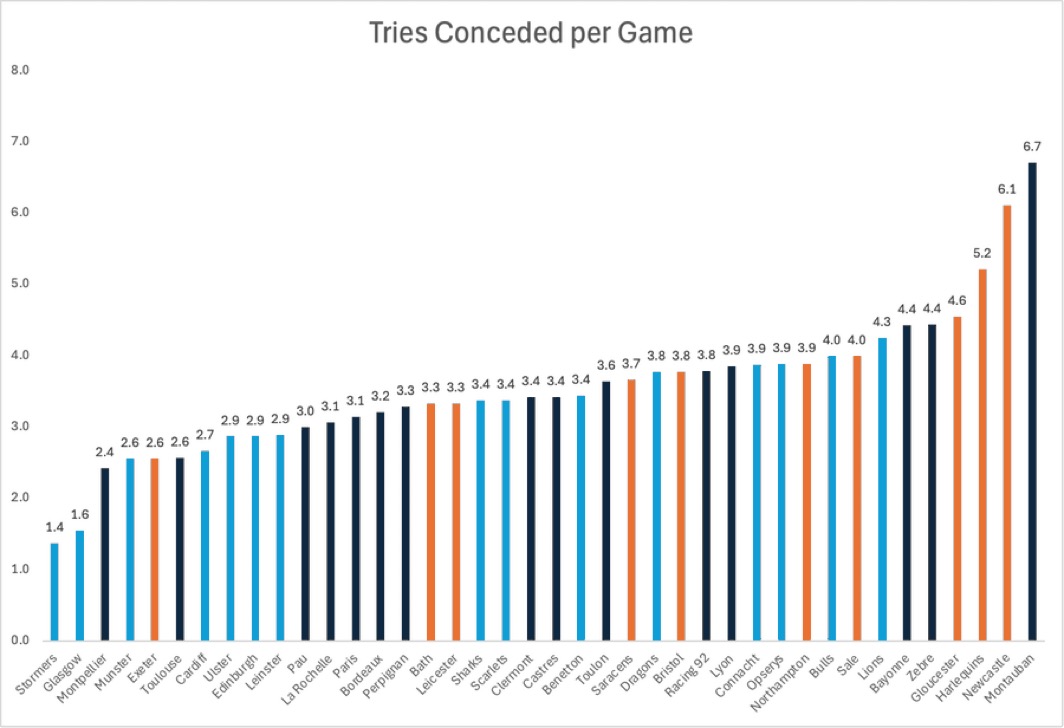
The stats the URC used to justify this rating were number of tackles made, number of tackles missed, tackle percentage, turnovers lost (which is an on-the-ball stat, not a defensive stat) and number of turnovers won. Points or tries conceded were not considered when rating a team’s defence. Hence, by the website’s same logic, they currently state that the best defensive team in the URC is the Dragons, who have conceded double the number of tries as the Stormers.
Final word on the misuse of tackle stats goes to former Wales head coach Gareth Jenkins who said, “Defensively we targeted areas that we actually achieved – we said we had to make 90% tackle completion and we did”. He was referring to a game that Wales lost 62-5.
Why is tackle success such an unreliable stat? As Larner puts it, “Missed tackles, confusingly, just don’t seem to matter when it comes to how many points you concede. Tackle success certainly has no real bearing on this overall metric. This is because not all missed tackles are the same”.
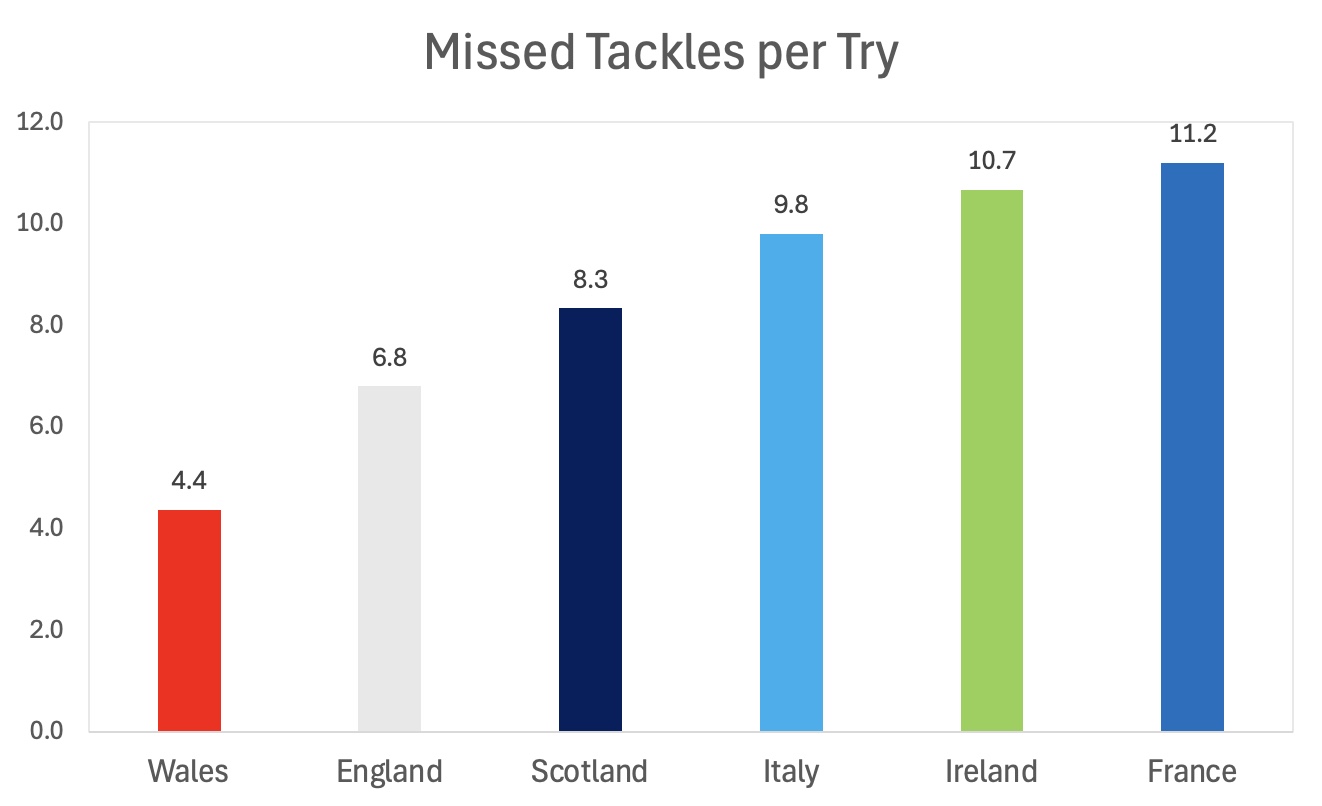
Missed tackles not all having the same result is something we can clearly see in this year’s Six Nations. After three rounds, Italy and England had both conceded 10 tries. However, Italy were averaging 10 more missed tackles per game than England. Clearly, the ‘cost’ of a missed tackle has no set value.
The notion of each tackle needing to be judged on its own individual merit is echoed by Smith: “Every [successful] tackle could have been a passive tackle, made behind the gain line, allowing the opposition to win quick ball without committing numbers. Another player may make only eight out of ten of his tackles, but he made his tackles past the gain line, put the runner on his back, shut down the offload, forced the opposition to send in three or four players to clean out. And maybe two of those tackles created turnover ball off which his team scored.”
One of Smith’s peers, France and former Wales defence coach Shaun Edwards, also explained the wider context of tackle success and how the overall figure can mask the true story of the defensive performance. After Wales were criticised for their missed tackle stats against Fiji at the 2019 World Cup, Edwards said, “I looked at that stat myself and realised we missed 25 tackles, then I thought to myself, who did we miss those tackles on? Then I looked and there were 16 missed tackles on both of their wingers [Semi Randradra and Josua Tuisova]… We only missed nine tackles on the rest of the team. Fiji was the only game we’ve hit our target. It was 15-17 points in that game and we hit that”.
This shows how elite level coaches do not judge a tackle simply on success or failure, but on their outcomes. The approach is supported by the statistics; writing for sports data provider Opta, Jonathan McCormick explained, “Defensive failures out wide are more damaging than in the middle of the pitch where things are more congested. In this year's Six Nations almost half (49%) of all missed tackles in the 10-metre channels have led to a try or line break, compared to just 31% from the section of the pitch between those areas. For line breaks themselves, 45% in the wide channels result in a try, compared to 32% infield”.
Even so, we still see that half of tackles missed go unpunished. This introduces us to the concept that tackles can be missed, yet still achieve their ultimate goal of shutting down an opposition attack. Rugby league writer Mike Meehall Wood explained, “The purpose of the tackle can be served without actually getting your opponent to the floor. The Stormers conceded 4.2 line breaks a game with 32.5 missed tackles, but the Sharks – the fewest misses in the comp – have more line breaks against, as do the Raiders and Eels. You can only miss tackles that you’re close enough to attempt, right?”.
Jacques Nienaber’s defence at Leinster and the Springboks is renowned for walking this knife edge of making missed tackles still have an impact. According to Ultimate Rugby, Nienaber’s Leinster missed the most tackles of any side in the URC, on their way to lifting the title last season. This is because Nienaber’s system, often described as aggressive and offensive, prioritises intensity and shutting down space over bringing players to ground. Leinster’s Garry Ringrose is often criticised for his volume of missed tackles, despite the fact the teams he plays for have some of the best defensive records in their respective competitions.
What often gets overlooked is that tackles are not a solo endeavour. Firstly, a common tactic in the modern game is double tackles, where two defenders tackle the same player. The prevalence of this tactic can often be seen in the number of tackles a team makes in a game exceeding the number of ball carries their opposition made against them. Opta track the number of carries that commit 2+ tacklers on their website and give the example of Wales committing 2+ tacklers with 72% of their carries in the first two rounds of the 2026 Six Nations.
Side note: this is often portrayed as a positive thing - the idea that drawing two tacklers with one carrier creates space for others - however it could also be a sign of an attack that is incredibly easy to read. For instance, the Scarlets rank in the top 5 in the URC for committing 2+ tacklers but are the only team in Europe yet to register a try bonus point. Meanwhile, Union Bordeaux-Begles have one of the lowest rates of committing 2+ tacklers and are widely regarded as one of, if not the most devastating attacking team in club rugby.
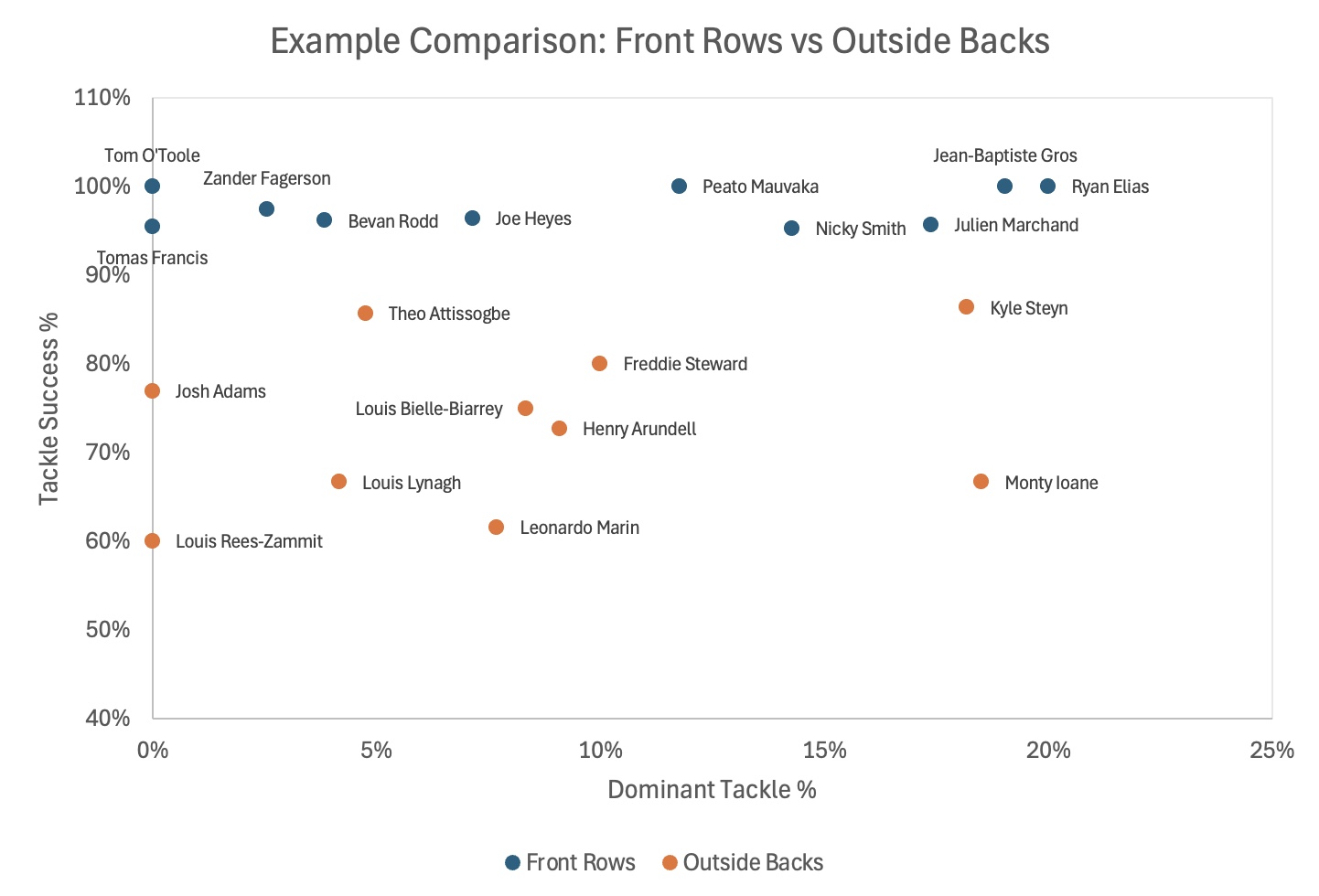
We must also consider who the tackle is being attempted on, and in what situation. If it is being attempted on a tight-5 forward who is picking and going from the base of a ruck, a missed tackle is extremely unlikely. Conversely, if a tackle is being attempted on a winger in 10m of open space, the odds are in favour of the attacker beating the defender. This is one of the reasons that wingers, fullbacks and outside centres, who mostly defend against the opposition’s best tackle evaders, often have some of the lowest tackle success. The tradeoff to this is that wingers can sometimes have a high proportion of dominant tackles, as they are usually tackling relatively smaller players, and kick-chases present opportunities to hit stationary opponents at speed.
Then, there is the question of whether the ball carrier is even trying to evade the tackle in the first place. It is not uncommon for teams to identify their opposition’s best player and send as many powerful ball carriers at them as possible, in an attempt to wear them out and limit their effectiveness. Defensive organisers and jackal threats are also often targeted by ball carriers because, by trapping these players at the bottom of rucks, they lose the value they would have brought if they were still on their feet.
Side note: this is my theory as to why Wales’ Jac Morgan’s tackle tallies are vastly greater than any of his teammates. Yes, his work rate is phenomenal, but as Wales’ best player and top jackal threat, opponents want him on the floor and out of the game as much as possible.
Of course, teams may also deliberately run at a player who has a reputation as a weaker tackler/defender. For example, Ireland fly-half Sam Prendergast attempted 20 tackles in the opening Six Nations game against France - the highest of any Irish player in that game. This was not because he was roaming the pitch, acting as an extra flanker, but rather because France had identified him as a potential defensive weakness and sent as many runners as possible directly into him.
Speaking of Sam Prendergast, we must consider tackle technique. Thanks to his reputation as a poor defender, Prendergast’s tackle technique has been the subject of a great deal of online scrutiny. Speaking on Prendergast’s technique, former Springbok fly-half and current Hino Red Dolphin defence coach Andre Pretorius said, “Prendergast is brave, but he gets into bad positioning when he gets into that engagement zone… 10s need to be more upright… If we come to the technique, you’ve got to give yourself an opportunity to withstand that first contact engagement. We call that the power position: same foot, same shoulder, get into that close zone, start the tackle with your shoulder, and end it with your legs.
“The other problem with Prendergast is his dip is way too early. I think, with him, he should be dipping as late as possible – he’s gonna be tackling 12s and 13s and 8s. he wants to give them a chest target, and then at the last moment change that target and force them to adjust. At the moment, they can just tuck their shoulder and they have the perfect target to hit”.
(please embed: https://youtu.be/9JjVBxg6bbs?si=tJ41JszyO0B6gBm4)
Pretorius contrasted Prendergast’s technique with other international fly-halves: “Sacha FM closes the space and has good technique. His tackles have a punch effect, he’s effective in that zone, and he’s got size, which helps. Ntamack and Crowley are both also strong in that regard.”
Tackle height is perhaps the biggest choice a defender has to make. Opta track what percentage of a player’s tackles contact above and below the ball carrier’s hips. A tackle below the hips is more likely to bring a ball carrier to ground but often concedes the gainline and allows the carrier to free their arms and make an offload. By contrast, a tackle above the hips - some times referred to as targeting the ball - is more likely to deny the carrier gainline success and prevent the offload, but brings with it its own risks.
We saw an example of ball targeting tackles backfiring in the Lions Tour of Australia in 2025. In the second test, the Wallabies repeatedly attempted this style of tackle, yet frequently lost the initial collision, allowing their opponents to fend them and gain considerable ground. If the tacklers had targeted below the hips, they may still have lost the gainline, but the ball carriers would have been brought down much sooner.
Returning to the subject of weaker defenders, we should now discuss a common tactic teams adopt to mask their defensive frailties. Quite simply, they stand these players in positions where they are likely to be required to make far fewer tackles. Pretorius returns to the example of Sam Prendergast: “You’ll see a lot of 10s defending at the back now because you don’t want them to take too many contacts. You can work around that with his positioning in the line – put him on the outside of the loose forwards, make him defender mid-mid-field. If the opposition plays off 10, then stand him just off the lineout.”
Changing a player’s defensive positioning not only affects the volume of tackles they make, but also the type of tackle they will have to make, i.e. front-on tackles or cover tackles. Data analyst Angus Usher explains, “You’ve got to see how certain players defend. I’ve seen big lads have howlers and I’ve seen smaller players make better tackles on the cover but less front-on tackles. The best example of that comparison would be Manie Libbok vs Handre Pollard. Who would you choose to defend at inside centre? Pollard every day of the week.
“Who is a better cover tackler? Libbok – he makes better recovery tackles; he has the legs for it, he is so quick and agile and he has a great rugby brain for defensive moments too. The quality of his cover tackles is so much greater than his front-on tackles, where he can be more of a speed bump. A lot of that is physics – he is 70kg and most players who run at the fly-half channel are 100kg. Pollard is almost the opposite. He’s the one you want in the close-contact scenarios, but in the wider channels he sometimes looks like Bambi on ice.”
However, Usher goes on to say that ‘hiding’ defensively weaker players is a tactic whose effectiveness is in decline: “As rugby evolves, the situation where we hide a player is fading away. In 15 years, a player like Willie Le Roux may not exist – he wouldn’t be able to get away with being a defensive weakness. I think that’s part of Rassie’s decision to select Sacha; he is an incredible defender, he is proactive, and he seeks the tackle.”
We see this not only with the earlier example of Sam Prendergast, but also with England scrum-half Alex Mitchell. In the first three rounds of the Six Nations, Mitchell attempted just 10 tackles - half that of any other 9 to start a match. This is because England place Mitchell on the wing in defence, where is required to make fewer tackles and more likely to face smaller ball carriers. Even so, his individual tackle success rate is still a lowly 60%.
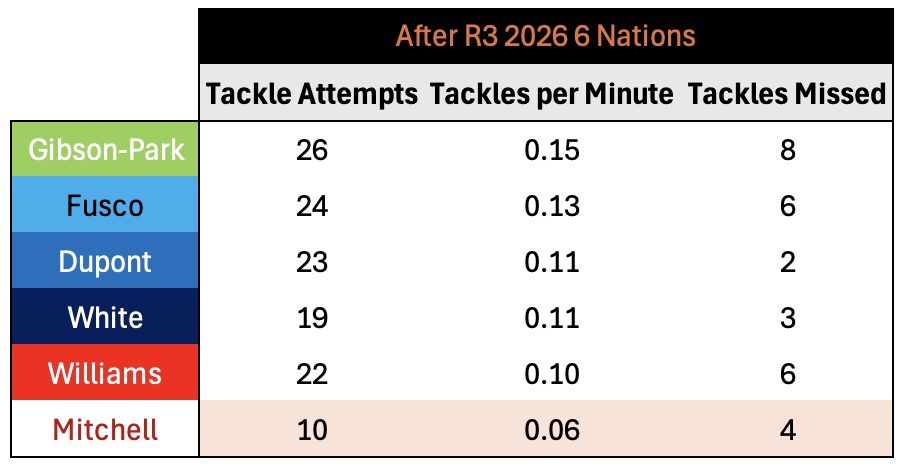
Just as Usher predicted, teams are becoming more and more adept at finding him and exploiting his fragility. Opta revealed that, of England’s 74 missed tackles in the first three rounds, 30% were within 10m of the touchline - the zone where Mitchell defends.
This is one example where we can actually learn something from tackle stats. If we consider the numbers on an individual level, rather than a team level, and compare their metrics to other players who all play in the same position, we can gauge how active a defender that player is and how effective they are when called upon to defend. However, as discussed earlier, these figures can be skewed by teams targeting certain opposition players.
Side note: this can be really insightful for fly-halves especially, some of whom are often their team’s top tackler, and some of whom barely ever make a tackle. Often, 10s who don’t make many tackles at club level can struggle when they step up to test level. This is something Angus has written about at length.
If we cannot rely on a team’s tackle success as an indicator of defensive robustness, are there any other stats we can use that would do a better job? Some coaches take matters into their own hands and create their own stats, as Smith explained: “At the Chiefs we rate each tackle according to its effectiveness. We collate an average score per tackle made in a game. There is a graph on my wall of the tackle scores made throughout the season. It gives the players a greater understanding of the causal effect of what they are doing. We have a benchmark tackle score that we always try to get above. If we do, we win. If we don’t, we lose. This chart seldom lies.”
For those of us who lack the expertise of a World Cup-winning defence coach, there are resources out there to help. Opta offer a club rugby stats hub with in-depth defensive statistics. Numbers such as gainline denial, percentage of missed tackles leading to a line break/try, and rucks per jackal provide greater insight into a team’s defensive characteristics.
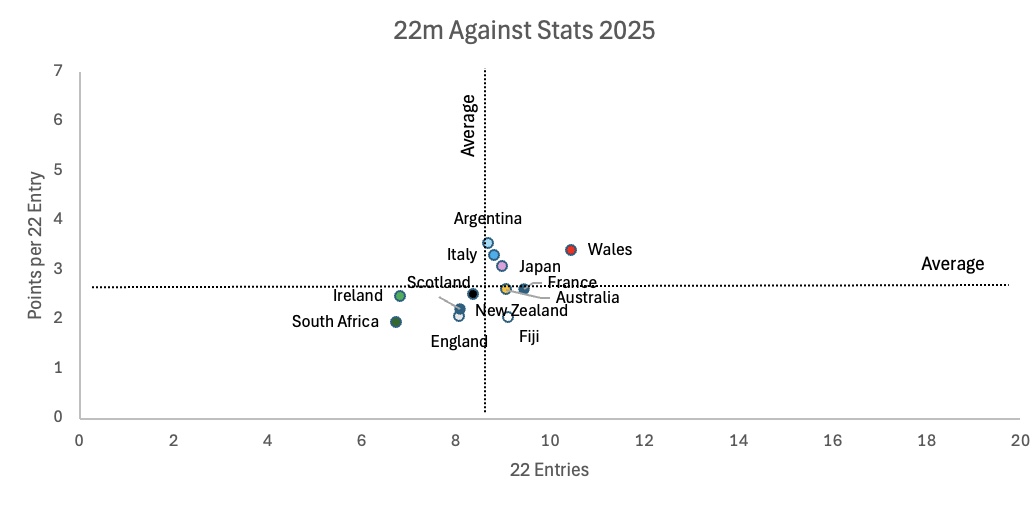
22m entry conversion against can also be a good indicator. The average points per 22m entry is around 2.9. So, if a team concedes more than that, we could say their defence was poorer, and if they concede fewer than that, we can say it was better. However, this stat is far more reliable if taken over a large sample of games, rather than a one-off match, which could be an anomaly. By adopting this approach, we see that the best defensive team of the world top 12, over the course of 2025, was South Africa, and the worst team was Wales, which is reassuring.
You can find the points per 22m entry stats on RugbyPass’s match centre, although you may have to make your own spreadsheet to track over multiple games. Of course, if all else fails, you can just follow Jacques Nienaber’s advice: “Points and tries conceded - it’s all that counts.”