Advertisement

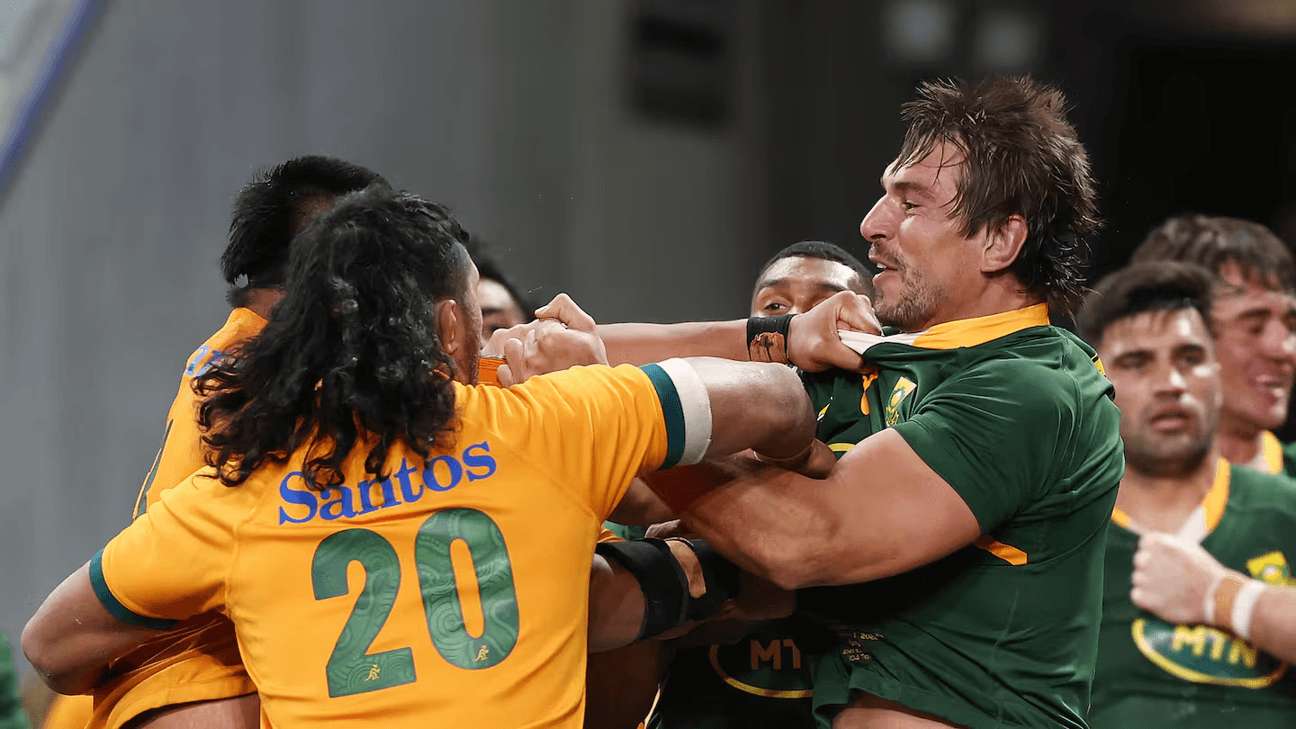


Australia have built some momentum. Now comes the test of how far they have really moved forward. The Wallabies welcome South Africa to Optus Stadium on Sunday 27 September unbeaten in five Tests, while the Springboks arrive following a 3–1 series win over New Zealand. With the Mandela Challenge Plate on the line, Perth offers the hosts an opportunity to turn an encouraging run into something more significant.
Both selections add plenty of intrigue. Les Kiss has moved Joseph-Aukuso Suaalii to the wing and loaded his bench with six forwards, while Rassie Erasmus has changed 13 members of his starting side. There is experimentation on both sides, but neither selection suggests this is being treated as a quiet stop on the road to the next World Cup.
Suaalii’s first Wallabies start on the wing is the headline Australian decision. He joins Max Jorgensen and Tom Wright in the back three, with Hunter Paisami returning at inside centre and Len Ikitau moving to outside centre. Kiss has identified the aerial contest, Paisami’s form and the balance required for a six-forward bench as factors behind the switch. It is a selection designed to address several challenges at once, rather than simply finding a different place for Suaalii.
The opportunity for Australia is to make that back three a threat rather than leave them fielding kicks all evening. Suaalii gives them an option to contest possession, but the support around the catch will be just as important. Secure the ball and move it before the defence resets, and there could be chances to attack. Win the catch but lose the next collision, and the territorial pressure remains. That is where the connection between the back three and the forwards becomes crucial.
In midfield, Paisami and Ikitau face André Esterhuizen and Canan Moodie. Esterhuizen captains South Africa for the first time, becoming the country’s 68th Test captain, with only Eben Etzebeth and Ethan Hooker retained from the starting side that beat New Zealand in Baltimore. For the new captain, the challenge is not just providing a direct carrying option. It is helping a heavily changed team settle quickly enough that Australia cannot turn unfamiliar combinations into defensive uncertainty.
Handré Pollard’s return from a calf injury should help that process. He partners Herschel Jantjies at half-back, opposite Australia’s Ryan Lonergan and Ben Donaldson. This looks an important examination of Donaldson’s decision-making: when to bring his midfield runners into play, when to attack the space behind the defence and when to accept that a good exit is enough. Australia do not need to manufacture something spectacular from every possession, particularly if doing so hands South Africa an easy attacking platform.
The Wallabies’ preparation has, however, taken a late hit. Josh Canham has been ruled out with a mild hamstring injury, bringing Lukhan Salakaia-Loto into the starting second row and Lachlan Shaw onto the bench. Jeremy Williams takes on the lineout-calling responsibility. Losing Canham matters beyond the change of personnel: Australia must now adjust an important part of their set-piece organisation immediately before facing the world champions.
The scrum offers another revealing contest. Angus Bell, Brandon Paenga-Amosa and Allan Alaalatoa start against Jan-Hendrik Wessels, Johan Grobbelaar and Zachary Porthen. Australia’s aim must be to establish dependable possession without allowing scrum penalties to dictate where the match is played. For South Africa’s starting front row, this is an opportunity to establish control themselves rather than leave that responsibility to the replacements.
There is an equally interesting balance in the back rows. Harry Wilson leads Australia alongside Rob Valetini and Fraser McReight, while Marco van Staden starts at No. 8 for South Africa, with Paul de Villiers and Elrigh Louw on the flanks. The breakdown could determine whether either backline gets the game it wants. Quick, secure possession would allow Australia to test those reshuffled combinations; slow possession would make every attacking decision more difficult. South Africa, in turn, cannot let their pursuit of turnovers compromise their own defensive organisation.
Then comes the bench battle. Australia have selected Billy Pollard, Aidan Ross, Taniela Tupou, Shaw, Tom Hooper and Carlo Tizzano, leaving Tate McDermott and Harry Potter as the two replacement backs. It is a clear investment in sustaining the forward contest, although the absence of a specialist replacement fly-half leaves less flexibility should Donaldson need to come off. The extra forward has to provide enough value to justify that trade-off.
South Africa have gone with five forwards and three backs, but the names matter more than the split. Malcolm Marx, Ox Nche, Wilco Louw, Lood de Jager and Jasper Wiese provide the forward reinforcement, with Morné van den Berg, Sacha Feinberg-Mngomezulu and Quan Horn offering options behind them. Wiese will reach 50 caps if introduced. That gives Erasmus ways to change both the physical contest and the attacking approach as the game develops.
Our call is South Africa by eight, but Australia have selected a side capable of making this uncomfortable. Their route to victory is to protect their set piece, turn aerial contests into usable possession and make the Springboks defend repeatedly before they can reorganise. For South Africa, the task is to establish control without assuming their replacements will rescue an untidy start. The Wallabies have picked enough attacking talent to punish that assumption; whether they can give it enough quality ball is the question.