Advertisement

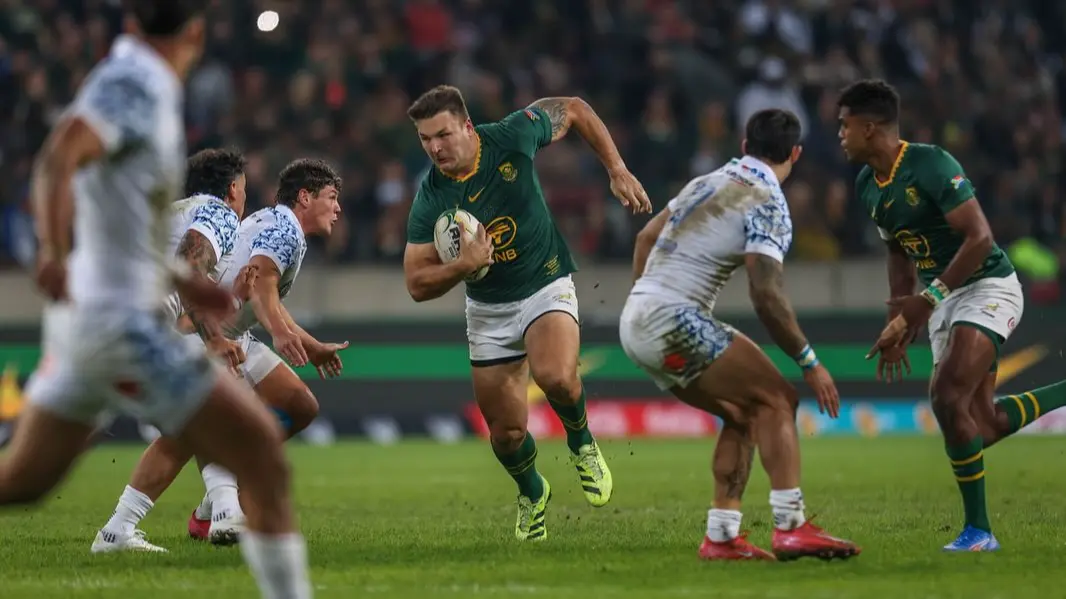


Rassie Erasmus has changed almost the entire starting side, but South Africa’s selection is about more than rotation. The Springboks have made 13 changes for their meeting with Australia in Perth, with André Esterhuizen taking the captaincy and Handré Pollard returning at fly-half. It is a chance to test different combinations without abandoning the experience around them.
André Esterhuizen will become the 68th player to captain the Springboks, leading from inside centre. His appointment makes this a significant occasion personally, but the leadership test is also a practical one: helping a reshuffled side find its rhythm quickly.
Alongside him, Canan Moodie starts at outside centre. The combination offers an interesting attacking possibility: use Esterhuizen to draw defenders into midfield, then create opportunities for Moodie beyond that initial contact. The key will be timing and support, rather than simply asking the captain to carry into traffic. That is the tactical opportunity suggested by the pairing, not a confirmed game plan.
Handré Pollard returns from a calf injury and partners Herschel Jantjies at half-back. With so many changes around them, their first task will be to establish control: clean exits, sensible territory and clear decisions about when to move the ball.
For this combination, the important measure will not simply be attacking highlights. It will be whether South Africa can keep their forwards moving onto useful possession and avoid forcing opportunities before the new-look side has settled.
Marco van Staden starts at No. 8, with Paul de Villiers and Elrigh Louw on the flanks. Selecting Van Staden there creates the possibility of using him and De Villiers together to pressure possession at the breakdown. My reading is that this combination could put greater emphasis on mobility and disruption, rather than relying solely on carrying power.
The balance matters. Contesting possession is valuable, but the back row must also protect South Africa’s own ball and avoid conceding penalties through overcommitment.
Erasmus has explicitly highlighted the mobility of his starting pack. He has also raised the possibility of Malcolm Marx appearing on the flank, with Jan-Hendrik Wessels moving to hooker. That remains a possible adjustment, not a confirmed substitution plan.
The replacements follow a 5–3 forwards-to-backs split, with Malcolm Marx, Ox Nche, Wilco Louw, Lood de Jager and Jasper Wiese providing the forward options. Morné van den Berg, Sacha Feinberg-Mngomezulu and Quan Horn cover the backs. That gives Erasmus scope to refresh the set piece while also changing the attacking tempo.
Wiese is set to earn his 50th Test cap if he comes on, adding another milestone to the occasion.
The interesting question is how those replacements are used. Do they enter with a platform already established, or are they required to recover control? The starting side’s performance will shape that decision.
The biggest question is not whether South Africa have selected talented players. It is how quickly this particular combination can function together.
Watch the connections: the delivery from scrum-half to fly-half, the support around midfield carries, the organisation after a kick chase and the speed of the defensive reset. Those details will show whether the changes have produced a connected performance.
The benchmark for this Springbok side should be more than a win: establish control early, create opportunities through the new combinations and give the bench a platform to build on.